
“Memento Mori”
Rev. Stephen Milton
Lawrence Park Community Church, Toronto
March 22 2026
Today’s sermon is a sermon by request. One of you asked if I could speak about the experience of going to funerals when the deceased is close in age to yourself. What does it mean to realize that you may be next? This person is a senior citizen, so he was speaking of the funerals of fellow seniors. Based on the tone of his voice when he asked me this, I sensed some surprise and a little unease. Funerals used to be about other people dying, now it has become much more personal. What if that was me up there in the urn or casket?
When I was in seminary, I dreaded the prospect of presiding over funerals as a minister. I had not attended many funerals, so I assumed that they would be times of great grief, difficult and sad. However, when I started presiding at funerals, I realized that they are one of the most profound rituals which we perform in churches. They are one of the few opportunities we get to see a life from beginning to end. Famous people get biographies written about them, but for the rest of us, a funeral may be the only time we get to hear an entire life story. How the hobbies and personality traits that appeared in childhood may have led to a career, or a passion for the arts or woodworking or sports that lasted for a lifetime. Or, in some cases, how a person changed substantially during their life. Sometimes due to an accident or trauma, perhaps an addiction. Other times it may have been a deliberate choice to change the way they behaved.
In religious communities, funerals seem to be inevitable, it’s just what we do. There are theological reasons for funerals: just as we were baptized into the faith, a funeral serves as the formal recognition of the end of a life and the beginning of our eternal life in Christ. There was a time when it was customary for caskets to bear the cloth a baby was baptized in, to underline this continuity. At the beginning of Christianity, many tombstones would record the exact day, hour and time of death. This was considered the deceased’s birthday, the moment at which they born into eternity, the start of their real life.
In our era, funerals are often less about the fate of the soul of the deceased, and more about the needs of the survivors. We need closure. We need to say good bye, to honour the person we loved and who has died. I have done lots of funerals at this church, and there is no consensus about what happens to the deceased after they die. Some families choose poems which say that the dead live on in our memories, but nowhere else. Others choose hymns and scripture which assume that there is an afterlife. But there is no agreement in the seats.
In today’s scripture reading, we heard about the famous raising of Lazarus from the dead. Lazarus and his sisters Mary and Martha were friends of Jesus. Jesus is 30ish, so it’s likely Lazarus was also a young man. So his illness and death do not mark the end of a long and fulfilling life. Instead, it is a tragic death, one that triggers days of mourning. He has been torn from the fabric of life, leaving a ragged , gaping hole. Mary and Martha are distraught - Lazarus was their beloved brother, and possibly their sole source of income in that sexist economy. Lazarus lived at a time when death was a regular visitor to people of all ages. Infant mortality rates were high- parents often watched their children die. About half of everyone born would die before the age of 20. Even after that people were not safe - disease, accidents, childbirth and violence could end a person’s life at any time. When a death happened back then, everyone could reasonably ask “ am I next?” No one had reason to be confident they would survive for years to come.
And in that way, they felt the same as the congregant who asked for this sermon. If we see someone die, and we wonder if we are next, what should we do about that? It depends on how you feel about your life. Are you satisfied with how life is going, with what you have done with your years on Earth? If you are, then you may not feel like you have anything important left on your bucket list. You may not welcome death, and would appreciate a few more years. But if you are satisfied with your life, thinking that you may be next may not seem tragic or disastrous.
But not all people feel that way about their life. Some look back and have great misgivings. Over things done, and things left undone. Of mishandled relationships, or a lack of accomplishments. Perhaps a sense that one never received the respect one deserved. It’s easy for our ego to find reasons that we didn’t get what we deserved. Our egos fear death the most, so a life lived in the ego can find the prospect of death very difficult. This may explain why our culture assumes that a longer life is a better life, so we need to prolong it as long as possible. Even when the quality of life declines.
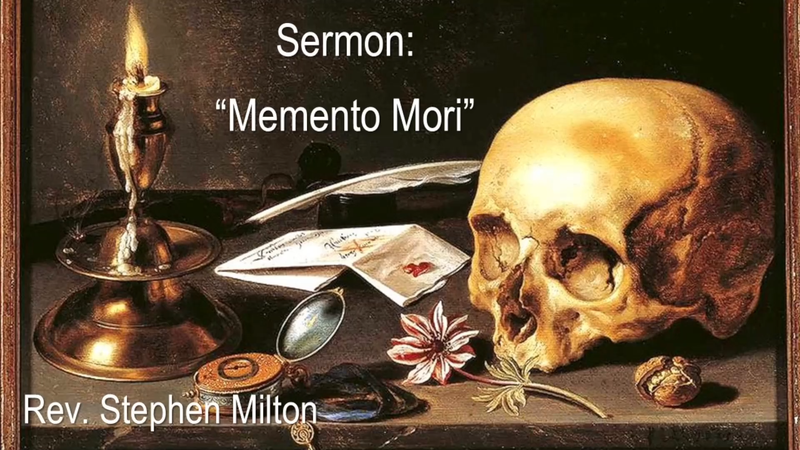
A few hundreds years ago, Christians had a saying for this kind of consideration of death: “Memento mori.” Remember death. Remember that death can come at any time, so make sure you are living well and righteously now. The medical revolution that extended our lives hadn’t happened yet. Shortly after the protestant reformation in the 1500s, many paintings emerged with this theme of memento mori. They weren’t subtle: usually there is a skull on a table of objects. Here’s one:
The skull suggests death, of course, but the objects on the table also covey a message. Many have to do with time running out - an open farmer’s almanac on the left side; a pocket watch in the foreground. There’s a book propped open to a sermon. A vase, which probably had flowers in it, has fallen over, empty. A human bone lies across the table. The document hanging down is Psalm 26, which pleads that God not end the life of a good person. The whole image is a reminder that death is coming, so live morally now before it is too late.
When our culture worries about death, it is usually about violent death from wars and murders. We don’t spend much time thinking about how death comes to most people, which is in old age. Funerals give us a reminder, though. Am I ready to die? Will I be satisfied with my life if I find out I only have a few months to live? What would I change in the time I have left?
In today’s scripture reading, Lazarus is brought out of the dark cave after four days of death. We can imagine him blinking in the light, confused and stiff from his time as a corpse. He has died and come back to life. What does he now think about his life, which was interrupted by death? Does he want to change things now that he is back? Does he want to repair any relationships? Get a different job? Spend more time with friends or on a hobby? We don’t hear much more about Lazarus in John’s Gospel, so we can only speculate. But we know that people who have had close calls with death in our time often do change their lives radically. Death has a way of giving us a greater appreciation for what is important in life.
None of us can go back in time to change our lives, so what matters most as we consider our lives is our attitude. Can a life which we found dissatisfying be changed in the time we have left? The events will remain the same, but how we approach life can be altered.
In one of Christ’s parables, he talks about a foreman who hires some day labourers ( Matthew 20). Some are hired in the morning, others at lunchtime, a few at the end of the day. When the shift ends, they line up to get paid. The workers are surprised to discover that the ones who were hired at the end of the day are paid as much as the people who worked all day. This is Christ’s way of saying that if you find the light of life even at the last minute, that counts as much as if you had it your entire life. Life is not about the quantity of years we live, but about the quality of consciousness we experience. A selfish life is a poor quality life whether it lasts 20 years or 100. A life of love and compassion, towards oneself and others, is a life well-lived , even if we die at 17 or 77.
As Christians, Jesus is our model of what a compassionate life can look like. In today’s scripture reading we may wonder where his compassion lies in letting Lazarus die. Why did he wait? When Jesus hears that Lazarus is sick, he declares, ““This sickness will not end in death. No, it is for God’s glory so that God’s Son may be glorified through it.” In John’s Gospel, when Jesus speaks of his own glory he means that his true nature as the Word will be fully manifested for the salvation of all. That can only happen through his death and resurrection. When Jesus is resurrected, that will open the door for eternal life for all human beings.
Jesus correctly guesses that raising Lazarus will cause trouble. More people will be convinced that he is the Messiah. The Temple leaders fear that if the people see Jesus as the Messiah, it will cause an uprising at Passover, and the Romans will launch a massive attack. They decide Jesus should be killed before he can cause any more trouble. So, when Jesus raises Lazarus, he knows he is setting himself up for his own death. This is where his compassion lies: in acting to save all of humanity and granting the gift of eternal life.
When Lazarus came out of the tomb, he didn’t know anything about this. He just saw that his friend had rescued him from death, returned him to life and the people he loved. What a gift. He probably had no idea that this act would trigger the events that would result in the death and resurrection of Jesus, which would change our views and experience of the afterlife forever. But what we know, 2000 years after he was revived, is that each of us has been promised a place in that eternal life. That even if we look back on our lives with some measure of regret, as followers of Jesus we have been assured that we need not fear death. In the Apostle Paul’s words, death has lost its sting. All God asks is that we live a good life, sharing the love we have received with others. Be gracious to each other, help those who suffer and who have been cheated by life.
When Lazarus died of illness, everyone around him had cause to wonder if they would be next. As Christians, we may feel that way at times, too. But thanks to Christ’s sacrifice on the cross, we are also promised that we will be next to experience eternal life. That is a gift. And we are promised that we can experience some of that heavenly solace in this life if we can live with compassion. It is never too late to resurrect ourselves to this new life, even if it is late in the day. Amen.
%20(4).png)