
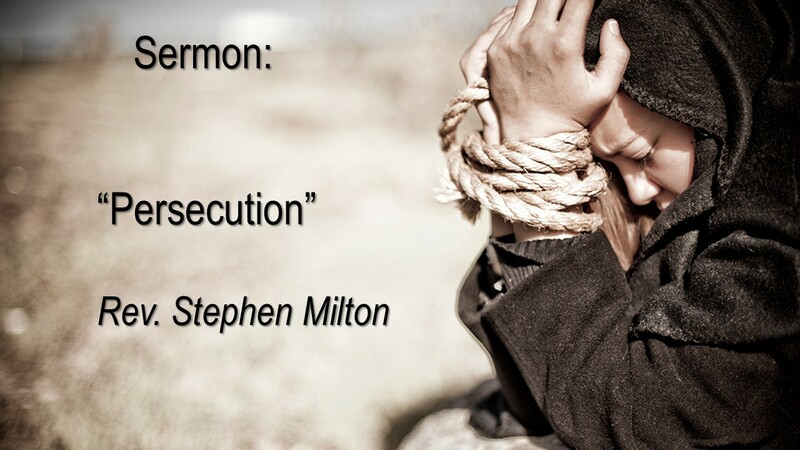
“Persecution”
Rev. Stephen Milton
Lawrence Park Community Church
May 3rd, 2026
Acts 7: 51-60.
Today’s scripture passage comes from the Book of Acts, a few chapters after what we heard last week. The Apostles are still in Jerusalem, spreading the word about Jesus. This angers some Jews who belong to a synagogue of freed slaves. They are tired of hearing the Apostle Stephen speak of Jesus as the Messiah. So they accuse him of blasphemy, saying that his Jesus threatened to tear down the temple. This gets the attention of the temple officials who bring him in for questioning.
Stephen is allowed to speak in his defence, since the charge is blasphemy. He gives a long recap of the history of the Jewish people which comes before today’s scripture passage. It ends with the assertion that the prophets have been predicting Jesus’ appearance as the Messiah. But, he says, the Jewish leaders of Jerusalem killed this Messiah. This accusation angers the Council, but it doesn’t seem to be what sets them off. Instead, it is when Stephen announces that he sees a vision of Jesus next to God in heaven. That vision is what angers the council members. In their eyes, Stephen has just proven the charge of blasphemy by claiming to see God. This is why they want to stone him to death, the traditional punishment for blasphemy.
This is a story about religious persecution. Stephen is killed because how he experiences his faith is unacceptable to others. The temptation to judge others, to demand that they perfectly follow religious rules and doctrines is strong. This is a temptation within religions, and between religions, too.
We are living in an era of widespread religious persecution. In many parts of the world, there are religions which are considered enemies of the state and society. In the years following the establishment of the state of Israel in 1948, Jews have been pushed out of most Muslim nations in the Middle East. Often this was done on the pretext that every Jew was suspected to be an agent of the state of Israel, and thus an enemy to Muslim states. Hatred of Jews has also played a major role. Before 1948, many Jews could be found in most Arab nations; that is no longer true in Iraq, Iran, Syria or Egypt.
Christians have also been targeted for their faith. In Pakistan, Christians are being persecuted so their lands and homes can be seized. It often starts with a charge of blasphemy. Christians are accused of insulting the prophet Mohammed or mistreating the Koran.
Pakistan
Churches are set fire, and so are Christian homes. Christians often have no choice but to flee the country.
Hindu attacks on Christians
In India, Hindu nationalists see both Christians and Muslims as enemies of the state. Over the holidays in December last year,
Hindu mobs vandalized Christmas decorations in a mall, harassed carollers, and schools were told not to celebrate Christmas. Christians are accused of forcing Hindus to convert, even though they make up just 2 percent of the population.
Here in Canada, we are not immune to these forces. On Thursday, I was speaking to a Rabbi on an interfaith walk in the Yonge and Eglinton area. He told me that his synagogue has film on its windows so that if someone shoots through them, the windows will not shatter. In the past two years, here in North Toronto, multiple synagogues have been defaced and even shot at. Last week, a man tried to force his way into a synagogue in Thornhill, and then roughed up a Jewish man as he walked towards his synagogue.
Canada claims to be a nation that welcomes all faiths equally. It is enshrined in our Charter of Rights. And yet, religious discrimination exists here. One quarter of Canada’s population lives in Quebec. In that province, Bill 21 stipulates that no public sector employee may wear any form of religious symbol while they are on the job. The Bill seeks to insure a firm separation of religion and state, including how provincial employees dress. In practice, the bill has most affected religious minorities, such as Muslim women who wear hijabs, Jewish people who wear kippah and Sikhs who wear turbans. They must choose between being loyal to their faith, or hanging on to their jobs. Last year, additional laws were passed to extend the restrictions to daycare workers, and even lunchroom monitors at city schools.
Montreal
Last week, it was reported that 150 employees quit Montreal’s largest school board rather than take off their hijabs and other religious symbols. The bill is now being considered by the Supreme Court of Canada, on the grounds that it may be unconstitutional.
I suspect the rest of the world would be very surprised to learn that in Canada, almost one quarter of our population cannot publicly wear a cross, turban , hijab or kippah if they work for the government.
While Quebec seeks to erase religious identity from public service, other governments are heading in the other direction. Tomorrow in Alberta, the leaders of the provincial government will be participating in an event called “The Alberta Christian Leadership Summit.”
Alberta 1
It is a meeting of Christian leaders and the members of the Alberta government to discuss how government policy can be aligned more closely with Christian values. Churches are encouraged to buy a ticket for 199 dollars so their pastors can attend.
Alberta 2a
Some of the talks include the topics of “Discussions on faith-based, independent schooling and parental rights,” medical ethics, and “How Alberta navigates and responds to federal legislation and national policy trends that may conflict with provincial priorities and the concerns of Christian communities.” Premier Danielle Smith will speak, and Preston Manning will be a keynote speaker.
This meeting is certainly not an example of religious persecution. Instead, it is an attempt by Christians and the elected government to harmonize their policies and values. That may sound like a dream come true, but it has other religious leaders worried. First of all, we should notice that non-Christians are not invited. The meeting suggests that Alberta is a Christian province. Constitutionally, Alberta is a secular state that is supposed to insure the freedom of all religions. This summit gives the opposite impression. Jews, Muslims and Sikhs have cause to be concerned when they see the Premier and so many of her cabinet taking part in this kind of meeting.
Indeed, a letter went out last week from religious leaders in Alberta expressing concern about the summit. The letter was signed by members of many religions, mostly Christians, including many ministers from United and Anglican churches across the province. They worry that many small congregations and racialized faith groups would be locked out by price. They also point out that as much as religious people hope governments will listen to their values, the faiths need to be careful about how close they get to governments:
“No single tradition, congregation, or political movement speaks for all people of faith. And the faith we know - across our many traditions - has never been most itself when it is closest to power. Rather, it has been most itself when it is closest to the people that power overlooks.”
In Alberta, there is a clear concern that evangelical Christianity is the government’s version of Christianity, and of course, its way of seeing Christianity is not universally shared. This may explain why so many members of the United Church signed the letter.
These same forces are at work here in Toronto at the municipal level. I have attended several events in the last year when Christians met with municipal politicians. One is a regular interfaith meeting with our City Councillor. The others, though, have been exclusively Christian. I attended a breakfast prayer service during Lent where there were extended prayers for every level of government. I also attended a meeting at City Hall in December.
Chow
City Councillors attended both of these events, and the Mayor spoke both times.
I got the sense that most of the Christians who attend these events are evangelical, and that they would welcome a blurring of the church/state boundary. Indeed, at the December meeting at City Hall, several City Councillors celebrated the fact that Christian groups were praying at City Hall before each City Council meeting. They saw this as progress.
I must admit that I have been uneasy at these meetings. In each case, there was a small band playing Christian music, and it was mostly praise music, the kind one hears at evangelical services. The crowd knew the songs well, and didn’t need the lyrics on screen. We may look at the United States and criticize the way right wing Christianity has infiltrated the white house. Please be aware, these forces are at work, here, too.
So, what is the right approach? Quebec wants a purely secular state that restricts religious freedom among its employees. That is both unconstitutional and it opens the door to the denigration and persecution of openly religious people, especially religious minorities. But on the other hand, should Christians or any other faith be allowed to have preferred access to government officials?
The United Church is a social justice-oriented denomination. We put less emphasis on saving souls than on saving the world. We believe Jesus calls us to help those who suffer and are marginalized. But, we also recognize that other faiths exist, and we do not have all the answers. We see Canada as a country of many faiths coexisting and co-operating to make our society more just. As the letter to the Albertan summit said, our goal is to increase the power of the marginalized, not draw close to secular power ourselves.
If one faith becomes the state’s preferred religion, then other religions can expect trouble. At best they will have less power, at worst, they may be persecuted, as we see in many countries around the world. This is why it is preferable to have an officially secular state which is elected by people of multiple faiths and no faiths. We can expect people of faith to want to work in government to put their ethics visibly into action - as teachers, as daycare workers, as medical personnel of all kinds. People of faith will also want to influence government policy based on their ethics. But it is too late to pretend that we are all the same, that everyone should be of one faith.
In today’s scripture reading, Stephen is the victim of religious persecution. His new way of seeing Jesus and God has offended the rulers of the Jewish council in Jerusalem. He has a vision of Jesus by God’s side in heaven. He sees something different from what these religious leaders see.
This is the reality we all face. Each religion sees God in different ways, and derives its practices and ethics from that vision. There is no time for each of us to learn the ways of all other faiths. It takes a lifetime to just learn the subtleties of our own faith. So, to get along, we must learn to be neighbours. Not because we approve of or even understand everything other faiths see. That is not possible. Instead, we must be ready to meet in the middle. To cooperate on issues that we all care about - issues of fairness, compassion, education, ways to flourish in this modern life.
Stephen wisely asks God to forgive those who persecute him. We , too, need to be tolerant of each others’ faiths. Perhaps this is what God wants most - not to see one faith triumph over all the others, but to see if we can find a way to get along as brothers and sisters of different faiths. To drop our stones, and build a society with them that is fair and just, playful and enjoyable, where everyone has enough for a good life. Amen.
%20(4).png)