
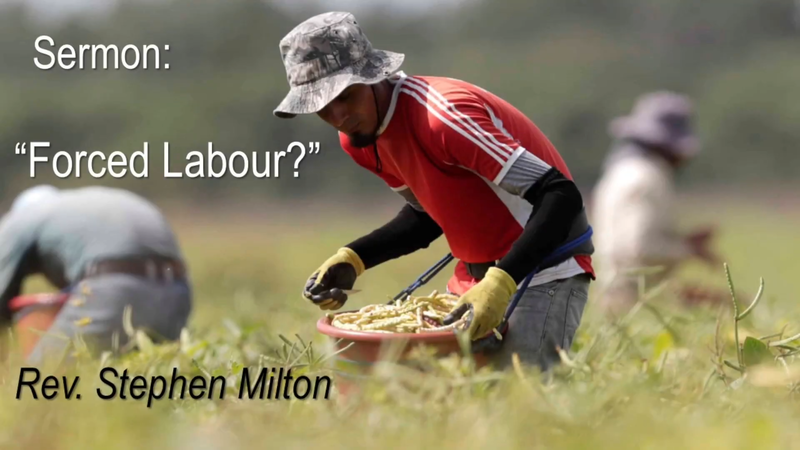
“Forced Labour?”
Rev. Stephen Milton
Lawrence Park Community Church,
August 2nd 2026
Yesterday was Emancipation Day in Canada. It comes on August 1st every year, recalling that it was on this date in 1834 that the British government outlawed slavery in all of its commonwealth nations. Canada was a colony back then, so this law applied here, too.
Slavery had been a big part of the British empire’s economy. The British controlled the transatlantic slave trade. Africans were kidnapped from their homes and taken across the Atlantic to the New World to work as slaves. It is estimated that 15% of the enslaved people died on those trips in filthy, crowded, stinking ships. They delivered Africans to countries like Jamaica, Cuba, Brazil, and the United States. Entire national economies depended on enslaved people to work on plantations picking coffee beans and cotton. The slave trade was big business, so ending it took many decades of protest and activism.
Christians were involved on both sides of the issue. Christian nations founded the slave trade and kept it going. Other Christians considered slavery an affront to human dignity and Christian values. For over a century, these two groups battled in the press, in parliament and in public assemblies. British and American Christians who opposed slavery often invoked scripture to make their case. Many used lines from today’s psalm. John Wesley, the founder of Methodism, wrote a blistering pamphlet against slavery in 1774. In it, he denounces the cruelty of slavery as it is found in the Americas:
Wesley 1
There must still remain an essential difference between justice and injustice, cruelty and mercy. So that I still ask, Who can reconcile this treatment of the Negroes, first and last, with either mercy or justice?
Wesley’s denunciation of slavery inspired many to join the abolitionist movement, to end Britain’s role in the slave trade and slavery in its colonies. At the end of his pioneering pamphlet, he prays to God in words borrowed from today’s psalm:
Wesley 2
God of love, thou who art loving to every man, and whose mercy is over all thy works…
His words are a deliberate echo of Psalm 145’s 9th line:
Wesley 3:
The Lord is good to all;
and his tender mercies are over all his works.
That idea, that God is good to all and offers tender mercies to all human beings was picked up by other abolitionists. Some American Christians agreed with Wesley that slavery was wrong. In 1790, an American Protestant minister, James Dana, denounced slavery in a speech in Connecticut. He, too, quoted from Psalm 145. Speaking of enslaved people, he said:
Dana
Have they been treated as children of the same family with ourselves? as having the same Father, whose tender mercies are over all his works? as having the same natural prerogatives with other nations? Or have they been treated as outcasts from humanity?
The British abolitionists won the fight against slavery in 1834. This was the work mostly of Christians, who made many enemies denouncing slavery. However, slavery continued in places outside the British Commonwealth. It took many years of protest and a civil war to bring slavery to an end in the United States. It was formally ended in 1865 with the adoption of the 13th Amendment to their Constitution.
Now, one might think that although this is an important piece of our history, it is not something we need to worry about today. There are no countries left who allow one person to own another.
But in the past two weeks, the issue of slavery has resurfaced.
Forced Labour Tariffs
Recently, the United States government accused Canada and 79 other countries of importing goods from nations who use modern forms of slavery. To punish us for this, we have received yet another tariff on our goods, to the tune of 10 percent.
The official term for modern slavery is “forced labour.” A person is forced to work for another person or organization, and if they refuse, they are punished, often physically. Forced labour comes in many forms: it can include children being forced to work as child soldiers for guerrilla militias; it includes sex trafficking where women are kept as slaves with no option to leave. It also includes forced labour by private companies, who often take advantage of vulnerable populations like refugees and migrants.
The Canadian government has argued that this new American tariff is frivolous since we already have laws on the books banning the import of goods made with forced labour. Indeed, many of the countries hit with American tariffs also have these laws, and the European Union is about to. So, the tariff looks like a ploy to replace tariffs that American courts have struck down. This is less about forced labour than Donald Trump’s love of tariffs.
That may be true. However, this is Emancipation Sunday. A time when we remember the Christian call that all people should be free, and that slavery is wrong. So, let us pause to consider the merits of this charge of condoning modern slavery. After all, it was Christians who worked hard to end slavery the first time. It remains incumbent on us to be concerned if slavery has made a comeback.
According to international labour organizations, forced labour does still exist all over the world. Few states engage in it officially, but many private organizations do. There are still many poor countries where crops are picked with workers who have no choice but to work or be punished. Children work in sweatshops and on plantations. The current estimate is that worldwide forced labour affects 50 million people.
And some of those people live here in Canada. It is estimated that 69,000 people in Canada live under conditions of modern slavery.
UN 1
Recently, a United Nations report highlighted several aspects of Canadian society that contain the conditions for modern slavery.
UN 2
The United Nations has said that some of our migrant labourers experience poor conditions and coercion that are equivalent to forced labour.
UN 3
In addition, Canada contains human trafficking rings where women and children are kidnapped then forced to provide sex with no opportunity to leave. This qualifies as slavery.
The United Nations Rapporteur also suggested that many missing and murdered Indigenous women may have been victims of human trafficking, a modern form of slavery. So, this problem does exist within Canada. Yet, none of this is what Trump cares about.
The new American tariffs target imports from countries where workers live under circumstances of forced labour. The American list of nations that export goods made with forced labour includes virtually every country that sends imports to the United States. Looking closely at the list, the Americans have highlighted any product that is suspected to have been made with child labour. This includes families who use their children to pick açai nuts in Brazil, to countries which pick coca beans using children. Nations who produce chocolate, like the Netherlands, are then targeted by the tariff. Canada is not accused of using forced labour in the production of goods. However, the tariff applies to us because we export goods that include materials from countries that used forced labour, based on the American list.
However, there is a deep irony to all of this. Although the Americans made slavery illegal in 1865, they also made forced labour legal in their country at the same time. The 13th amendment in their Constitution provides a slavery loop hole. It is very short, it states:
13th Amendment:
Neither slavery nor involuntary servitude, except as a punishment for crime whereof the party shall have been duly convicted, shall exist within the United States, or any place subject to their jurisdiction.
In other words, no one can be enslaved, with one exception: convicts. They can be forced to labour against their will, with or without pay. This new kind of slavery started right away after the end of the Civil War. Laws in the southern states were changed so that Black men could be arrested easily on frivolous charges like vagrancy. These men were then forced to work in chain gangs, where they sometimes worked on the same plantations where they had been enslaved just a few years before.
Today, this practice is big business in the United States. They have the world’s biggest prison population in the world, with almost 2 million people behind bars. Most of those prisoners are forced to work or they face punishment. This is the definition of forced labour. Most convicts work inside the prisons to maintain them. But, many are also leased out to private corporations who get workers who have no rights, no choice, and are barely paid. In many southern states, prisoners are paid a few cents an hour, or nothing at all.
The use of convict labour is a major part of the American economy now, with major corporations relying on this cheap forced labour to produce fast food, work in call centres, and work in slaughter houses. The federal and state governments even use forced prison labour to fight forest fires.
So, although the American government forbids the importation of goods made with forced labour, it counts on its own large forced labour force to play an important part in its economy.
This problem is well known to Canada. Over one hundred years ago we enacted laws to restrict the importation of American goods made in prisons precisely for this reason. Indeed, last year, a University of Toronto report urged the Canadian government to take more care to block goods from the United States that are made with prison labour. Millions of American convicts are being forced to work against their will in what amounts to a modern version of slavery.
Slavery in the Americas
For this reason, America is counted as the biggest source of forced labour in North and South America. 1 million people are considered slaves in the United States right now. However, if you look closely on this chart, you can see Canada is here, too, but far from the top.
As I mentioned earlier, the UN believes that sex trafficking and migrant labour is a source of modern slavery in Canada. However, It did not cite our prison system as a source of modern slavery. Our prisoners are also paid to work, but they can legally refuse to work, so this does not constitute forced labour. However, their wages are very low: no more than $ 6.90 a day. Their pay has been frozen since 1981. The conditions are better than in the United States, but Canadian prisoners have no labour rights, no chance of unionizing or using collective bargaining. It isn’t slavery, but it isn’t fair, either.
As Christians, we do not have to choose between being for Canada and against other nations on social issues. Our primary loyalty is to God, who calls for us to stand up for all people who face oppression. As today’s psalm states, we gather to celebrate God’s acts of redemption of oppressed people in the past, and we pass on these stories from generation to generation. Indeed, we are called to be part of that movement towards greater freedom. So on this emancipation Sunday, let us remember how we have changed our societies to end slavery, and also stay watchful. Let us not condone modern forms of slavery just because they don’t look like old forms of slavery. On this emancipation Sunday, let us remember the words of today’s psalm:
The Lord upholds all who fall
and lifts up all who are bowed down.
The eyes of all look to you,
and you give them their food at the proper time.
You open your hand
and satisfy the desires of every living thing.
(Psalm 145)
May we join God in this saving action for all who suffer and are at risk. Amen.

%20(4).png)