
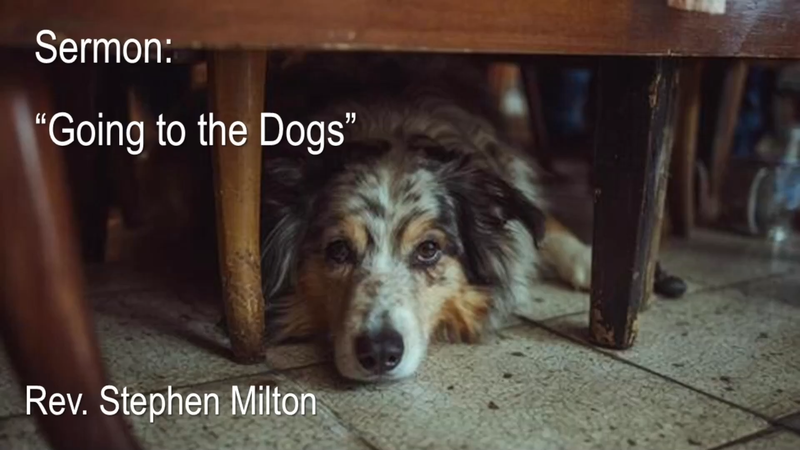
“Going to the Dogs”
Rev. Stephen Milton
Lawrence Park Community Church,
August 16th 2026
“Going to the Dogs” Sermon
Rev. Stephen Milton
Lawrence Park Community Church
Scripture: Matthew 15: 10-20; 21-28.
This morning I want to do something a little different. Today’s scripture reading is a really interesting one, but it is also subtle. So, I would like us to spend some time inside it, slowing it down so we can discover some of the subtler meanings and insights within it. To do that, I would like to ask our two readers to stay on stage, we will be needing you to read again in a little while.
In today’s reading, we hear Jesus explain his view of what makes a person impure. He disagrees with the Pharisees. It’s not what you put in your mouth that is the spiritual risk. Not food or unclean hands. No, it’s what comes out of your mouth that counts. That is, bad words, insults, lies, orders to kill or hurt others. And those words and actions are not created by your tongue, but by your heart. Your inner will. What we would now call your consciousness, how you feel and think. If you harbour hatred and bitterness, then those impulses will make you impure, and you will do impure things.
So Jesus argues that the heart, not food, is what matters most in the spiritual life.
Then Matthew says that Jesus left that place to go to the coastal city of Tyre. Most of the people living here were pagans. They worship multiple gods, and eat meat sacrificed to the gods. All of this is considered impure by the Jews. So, after talking about purity, Jesus goes to a place most Jews would consider impure by definition. And it is here that he encounters a pagan woman who starts yelling at him:
Beth ( loudly): “Son of David, help me! Son of David, help my daughter! She’s suffering! She needs your help! Help me Lord!”
At first, Jesus ignores this pagan woman. He knows that by Jewish rules, she has no business talking to a strange man, much less a Jewish rabbi. He has every right to ignore her.
It’s only after the disciples tell him to send her away that Jesus answers:
“I was sent only to the lost sheep of Israel.”
Jesus is saying that according to prophecy, the Messiah is meant to save the people of Israel . They have lost their way spiritually. They are the ones who need a good shepherd.
But that does not stop this woman, who is a mother. She gets down on her knees and says:
“Lord, help me!” [ you don’t have to get on your knees]
“It is not right to take the children’s bread and toss it to the dogs.”
Ouch! This woman is literally on her knees before Jesus, and he looks down and says it is not right to share the Messiah’s power with dogs. We may love our dogs like children now, but we still understand that to be called a dog is not a compliment. In Jesus’ time, dogs were scavengers, they ate anything they could find. That meant they ate foods Jews considered unclean, which made them unclean. Jesus is saying pagans are like dogs, unclean. It sounds like an insult, and it is.
So, let’s return to Jesus and the pagan woman. Let’s play that scene again, but this time with some added lines.
“Lord, help me!”
“It is not right to take the children’s bread and toss it to the dogs.”
“Dogs? Dogs?!!! You, an outsider from Galilee, you dare to call me a “dog?” You say this in our city, in our home? And when you say “dogs,” you say this after I have begged you, on my knees, to help my sick daughter. Is she a dog? Am I a dog? Are all my people here, dogs? I ask for help and this is how you reply? What kind of healer are you? I see a dog here, and he stands before me, eating our food and drinking our wine. And you dare to call us dogs?”
Okay, let’s stop there. You get the idea. This conversation could have easily gone that way. She could have stood up for her people and her daughter. That would have been entirely consistent with human nature. You insult me, I get defensive, my ego strikes back. Happens all the time, in our homes, at work, on the streets. This is Ego 101.
But note, friends, that is not what happens in today’s scripture reading. The woman does not get angry or defensive. Instead, she replies calmly. So, let’s replay that scene the way it is written:
“Lord, help me!”
It is not right to take the children’s bread and toss it to the dogs.”
“Yes it is, Lord, Even the dogs eat the crumbs that fall from their master’s table.”
Before we get to what her statement means, notice that she isn’t angry. She is not defensive. This is a woman whose ego has not taken over her self. She has been insulted, but she hasn’t hit back with more insults or by striking Jesus. Instead, she stays calm, her ego has not taken offence.
Now, remember back to what Jesus said earlier about what makes a person impure. He said, it is not the food they eat, but the state of their heart, their state of consciousness. And here, in the very next story, we meet someone whose heart is very good. She is called a dog, but she doesn’t strike back in anger. What is coming out of her heart is not bitterness, but concern for her daughter. And she stays calm. She is an example of the kind of heart that is pure, which Jesus was speaking of before he arrived in this town. And what’s really interesting is that the example of a pure heart is not a pious Jew, but a pagan, and a woman at that. The implication is clear - such people of good heart can be found everywhere, in all religions.
But she is not the only person here who has an ego. Here’s another way this discussion could have gone:
“It is not right to take the children’s bread and toss it to the dogs.”
“Yes it is, Lord, Even the dogs eat the crumbs that fall from their master’s table.”
Jesus ( cold, slowly): “What did you say to me? You call me “Lord,” but you dare to lecture me? You are on your knees begging for help, but you are giving me orders? Dogs do not tell their masters what to do. Do you have any idea who I really am? If you knew, you would wish you were under the sea with your mouth closed rather than giving me orders. Get out of my sight before anything worse happens to you!”
Doesn’t sound like Jesus, does it? Jesus doesn’t talk that way. He doesn’t pull rank, and he doesn’t belittle people. But he could. He has critics who insult him all the time. But he doesn’t lash out from a position of personal hurt. Like the pagan woman, he does not act out of ego. He could have been insulted that she was contradicting him. But his ego is not in charge, he is too merged with God’s consciousness for that. So instead, he can simply listen to what the pagan woman has to say and evaluate it on its own merits. He doesn’t take it personally.
This exchange between Jesus and the pagan woman suggests a better way of living, where egos are not in the driver’s seat. I think we have all seen what happens to politics when egos take over. It is destructive and dangerous. The same is true in our personal lives. People who have wounded egos make trouble everywhere they go. They act out of fear and anger, blaming others for their own problems. They can barely hear what others are saying when they feel under attack.
This story of Jesus and the pagan woman shows an alternative, when egos are not in control of our actions. But this isn’t some kind of Zen paradise. Real problems persist. This woman’s daughter is terribly sick, she needs healing. Jesus and this woman may be spiritually enlightened, but they still start off on different sides of the issue about what to do next for the girl. So, this interchange is not about what happens in a perfect world where people have no egos and everything is perfect. Far from it. This is the real world, where even spiritually evolved people disagree. But what’s important is how they deal with their differences. This is an example of how problems are addressed among people who have dialled down their egos.
This is not a superhuman ask. We have all been in situations where most people are reacting with their egos, but one person stays calm. Perhaps it was a good boss at work, or a teacher at school. Someone who could brush off insults, and just stay focused on the problem at hand. They don’t tell you that they deserve your respect, they simply act in a way that earns it. This is possible for us mere mortals.
The question is how to get there. Feeling genuinely loved and supported seems to be the key. People from loving families can remember that even if others insult them, their family still loves them. That helps a lot. That can lead to good self esteem, and a strong sense of self. A wounded self can make a lot of trouble, it can insist on external validation in a way that is not healthy. We see that every day with the American president. No achievement, no amount of money, is ever enough to make him feel secure and loved. What is needed is an internal sense of security. And that comes from feeling loved.
Our faith is realistic about this. Families don’t always offer that kind of love. And even when they do, family members can change over time, and even the most loving parent or sibling may die. We don’t always have that support system. So, Christianity reminds us that all the love we ever felt, that made us feel safe, really came from God. God created your loving family, and God is love, every time it is expressed. Love is what can calm our worried ego so it can be set aside without freaking out. We have the ability to connect directly with that divine love, that ultimate source of security. When we do, our ego calms down, and we can let love take the wheel. You have met people like this. They are among us. People who do good things but don’t brag about it. Their egos are not in charge. Each of us can be like this for others, some of the time, or none of the time. It is up to us whether we accept this love, and the security it provides.
Jesus tried to make it obvious. He went to the cross to remind us that we are loved.
And there is another feature of this kind of loving perspective on life. It helps us act for others out of love. The pagan woman in today’s story is acting out of love for her daughter. But her words also benefit others, too. She reminds Jesus that God’s love - those crumbs that fall from the table - are meant for everyone, not only the Jews. She is reminding Jesus that his mission is for the entire world. Not just her, or her daughter, but all people.
And, Jesus, being open and not prone to insult, sees that she is right. He knows the prophecies. He knows God’s love is meant for all, but he needed a reminder. And he takes it from a strange woman he could have ignored.
This exchange is part of the reason all of us are here. Most Christians have ancestors who were pagans, not Jews. That pagan woman’s ability to not take offence gave us all an incredible gift, the extension of this faith to all of peoples.
And let us not forget how this meeting ends, with another gift:
“Lord, help me!”
“It is not right to take the children’s bread and toss it to the dogs.”
“Yes it is, Lord, Even the dogs eat the crumbs that fall from their master’s table.”
“Woman, you have great faith! Your request has been granted.”
and her daughter was healed at that moment.
May we all be healed, too. Amen.

%20(4).png)