
Feast of Creation in Christ
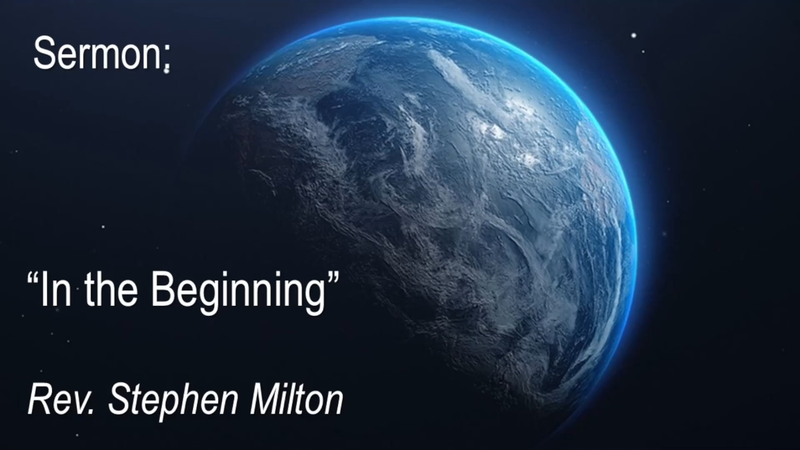
When did the world begin? Scientists tell us the Big Bang occurred 13.8 billion years ago, although that age is always being adjusted based on data from telescopes that look at the oldest stars. Christianity has its version of the birth of the universe, too. It is more poetic than strictly factual. It describes the creation of the world and all the universe as something that happened over the course of six days, followed by a day of rest. Even in ancient times, the faithful agreed that those days were probably longer than days are now, being God’s days. But when did that first day of creation happen? Not just how many years ago, but on what date? Was it on the 22nd of October, or December 31st or January 1st? Creation must have started some time, so on what day in our calendar did it begin?
I can see from your reactions that you are stumped, but some Christians do have a clear answer to that question. In the Greek Orthodox tradition, they have been celebrating the birth of the universe since the 5th century. They believe the universe began on September 1st, which this year means last Tuesday. Why September 1st? There were rational and spiritual reasons for the 1st of September. In the early centuries of Christianity, theologians studied the Bible to discover how old the world was. How many years ago did God create the universe? Tracing back the generations and events mentioned in the Hebrew Scriptures, Christians in the eastern part of the Roman Empire concluded that the universe was created 7535 years ago on September 1st. They chose the 1st of September because that was traditionally when the harvest was brought in, and the day they believed Jesus’ ministry began. It also happened to be the start of the Roman fiscal year. It was a day of new beginnings, and an excellent time to celebrate creation.
For the Eastern church, this also meant that their calendar started at the beginning of time itself. But the Western branch of ancient Christianity took a different route. Instead of reckoning time in terms of the birth of the world, the Anno Mundi, they chose to reckon time in terms of when Jesus was born. Jesus had reset the clock of the world through his saving of the world from sin, so they decided to calculate all dates relative to his birth. So, this year is 2026 AD, where the “AD” is short for Anno Domini , that is, the year of our Lord. For time before Christ’s birth, we refer to those years as B.C., before Christ. In our culture, time is literally defined by Christ’s birth. More recently, these terms have been changed to BCE and CE, before the common era, and the common era. This is more respectful multiculturally, but the dates remain pegged to Christ’s birth.
If time itself is tied to Christ, then it matters who we think Christ is. Christianity shifted from measuring time in terms of the age of the universe to the age of Christ. In our scripture readings today, we heard the opening lines from the Gospel of John. In it, we are told that in the beginning was the Word. The Word made of all of creation with God, and was God. But this Word is also the being of God who decided to take on human flesh and become Jesus of Nazareth. John’s Gospel is saying that Jesus’ identity did not start with his birth in the stable 2000 years ago. Jesus was already God long before that, living with God and the holy spirit in heaven even before there was a universe, before time or matter existed. Jesus is the physical incarnation of Cosmic God, God’s human avatar, to put it in video game language. So, Jesus and creation started off intermingled in Christianity. You couldn’t talk about nature without also talking about its Creator, the Word, who was also Jesus.
That idea was maintained in Eastern Christianity, but it slowly faded in the West. For most Christians in the West, Jesus is the moral side of God, the saviour of humanity. It’s as though Jesus, God and the Holy Spirit are in charge of different departments. God creates the universe and the Earth, while Jesus takes care of human affairs. Jesus came as a human, taught humans, saved our souls through his death and resurrection. For most Western Christians, Jesus was seen as the mediator between human beings and God the creator. Jesus’ role in creation faded away.
Over time, we lost sight of Jesus’s role as the creator of nature. And that slow disconnect happened at the same time as Western society became disconnected from nature. The idea that nature was sacred used to be obvious - God created it, how could it not be sacred? But with the rise of industrialization in the 19th century, nature lost its sacred dimension. The Church also lost authority as science discovered the world and the universe was far older than the Bible suggested, and Darwin challenged the seven days of creation account, suggesting life had slowly evolved. Church authority slipped at the same time as industrialization grew in power. Nature came to be seen simply as resources to be dug up or chopped down.
Non-European cultures, like Indigenous peoples, strenuously objected to this shift and its consequences, and they still do. To them, nature is still sacred. But to most people in the West, religion and the physical world exist in two different categories. Religion is presented as a question of personal moral conduct, where we follow Jesus, the moral messiah. We assume that science will tell us how nature works, and the economy will decide what we do with forests, fields and oceans.
However, not all Christians see it this way. The Greek Orthodox churches continued to see Jesus as the Word, the creator of the universe. And not just the part of the universe that affects us directly, such as our pets and nature on Earth. Jesus created all of the universe, including the stars, the black holes, the quasars, and the trillions of galaxies. All of it. And they continued to celebrate Jesus as the creator of all on September 1st, in their feast of creation in Christ.
And in 1989, this man had an idea. He is the Ecumenical Patriarch Dimitrios 1 of the Eastern Orthodox Church. In 1989 he approached the Western churches with a suggestion. He said that since nature is in so much trouble in our times, now would be a good time for Christians of all denominations to come together.
He suggested that all churches adopt September 1st as the feast of Creation in Christ. It was time, he suggested, for Christians to celebrate not just Christ’s moral teachings, but the sacredness of all nature, as an act of Creation by Christ. He also introduced a slight change to the feast. In addition to celebrating God’s creation of the universe, all Christians should be invited to pray for creation’s welfare.
For, as we are reminded in today’s psalm, creation is not just for us. In Psalm 148, the psalmist invites every part of creation to praise God. Not just human beings, but every creature, every animal in the sea and on land, every star, the sun and moon, every part of creation, including those we do not usually consider conscious. Our view of creation seems very narrow compared to the view in this Psalm written centuries before Christ. Our belief that we are the only ones on this planet who are aware and which feel pain has led us to change the climate, bringing on fierce storms and droughts, flooding in our city streets as we saw this week, and horrific wildfires. This is a good time to start praying with and praying for creation. That was what the Patriarch Dimitrios had in mind when he invited all Christian churches to join in the feast of Creation in Christ back in 1989.
That was 37 years ago. Change takes time in the Christian world. The idea slowly worked its way into the Christian churches in the West and around the world. Our four week-long season of Creation, which starts next week in the United Church, was inspired by the Patriarch’s suggestion. The Catholics introduced a day of prayer on September 1st during the papacy of Saint Francis in 2015. And in 2024, meetings were held in Italy among all the major denominations and the World Council of Churches to discuss the idea.
The result is what we are doing today. We are joining the Greek Orthodox, Roman Catholic and Protestant denominations all over the world in celebrating Christ’s creation of the universe, and praying for the welfare of nature itself. At a time when secular governments can’t seem to agree on much internationally, Christians all over the world are standing up to celebrate this sacred Creation of which we are part, and which sustains us; which we are called to protect; and which extends far beyond this small blue planet to include all the galaxies far beyond our sight. This feast is not mandatory in our kind of denomination, but I hope it will be observed this year and in the years to come. A prayer of thanks for Creation, and a prayer for Creation’s welfare. And a proof that Christians can come together despite all our differences. That, surely, is a good sign, too. Amen.

%20(4).png)