
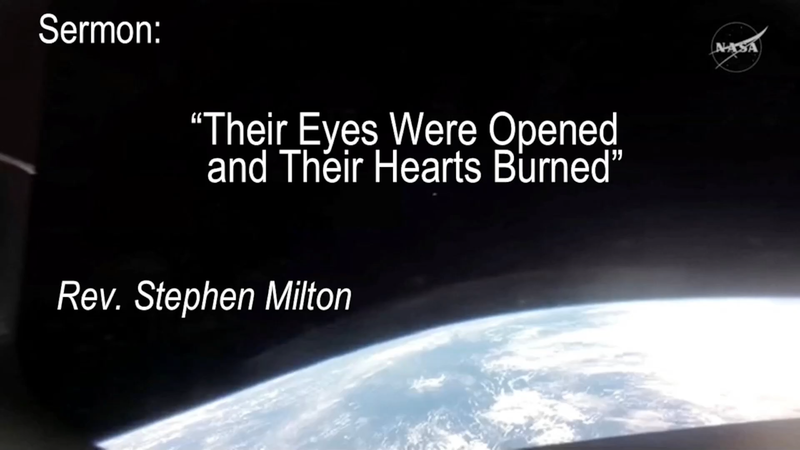
“Their Eyes Were Opened and their Hearts Burned”
Rev. Stephen Milton
April 18 2026
Lawrence Park Community Church
Luke 24:13-35.
Over the past few weeks, we have been hearing resurrection stories. Today’s passage comes from the Gospel of Luke. It takes place after the women’s visit to the tomb. They have hurried back to the disciples in Jerusalem to tell them about the empty tomb and seeing angels. But most of the men dismiss their story as just the wild imaginings of women. They don’t believe Jesus has been resurrected. They saw him die, and they believe he has stayed dead. Two of the disciples are so depressed by this turn of events that they decide to give up and go home, game over.
These two people are the ones Luke introduces us to in today’s reading. One is named Cleopas, the other is unnamed. They may be husband and wife. It wouldn’t be the first time a woman was left unnamed in the Bible. And as they walk, Jesus shows up. But Luke tells us that he hides his identity from them. That’s strange in itself. But so is what they talk about. They tell Jesus about the recent events in Jerusalem. Their leader, the one who was supposed to redeem Israel from its enemies, has been killed by the Romans.
Now, one might expect Jesus to reveal himself at this point. He could have taken the veil from their eyes and said, here I am, worry no more! Rejoice! That would be a loving thing to do. But that’s not what happens.
Instead, for the next few hours, Jesus talks to them about the scriptures. Up until this point, the disciples had assumed that the Messiah would be a warrior, a hero who would rescue Israel from the Romans. That’s certainly how it sounds when the psalms and prophecies describe what the Messiah will do when he comes. But Jesus spends the hours walking with these two suggesting another way of reading the scriptures. One that was less literal, and more nuanced. One where God’s love for Israel includes allowing the Messiah to be treated badly so that Israel could be saved. The people were not saved through warfare, but through a revolution of the heart.
In fact, Jesus has chosen to teach them this lesson rather than reveal himself to them. For Christianity to flourish, Christians will need to adopt a different kind of consciousness, one where love, even in the face of death and suffering, must prevail. Love as the strategy, instead of hoping for God to solve our problems with violence. This is a new kind of consciousness, a new kind of awareness. It will lead Christians to read scripture differently, more metaphorically than before.
Now, this may sound like an academic exercise, something only theology geeks would care about. But this does matter, even now. You may have seen in the news lately that the Trump administration has been picking fights with the Pope. Trump has released a picture of himself as Jesus, and the Vice President has lectured the Pope about the theology of warfare.
This debate began three weeks ago when Pete Hegseth, the Secretary of War, led a monthly prayer service at the Pentagon.
Hegseth
In it, he quoted from a prayer recently written by a military chaplain. It included these words:
“Give them wisdom in every decision, endurance for the trial ahead, unbreakable unity, and overwhelming violence of action against those who deserve no mercy. Preserve their lives, sharpen their resolve, and let justice be executed swiftly and without remorse, that evil may be driven back and wicked souls delivered to the eternal damnation prepared for them."
These phrases are lifted from scripture, a mashup of different lines from several psalms. And it is true that many psalms do call for God to subject the enemies of Israel to great violence. It was these kinds of psalms that had informed the expectations of the travellers who were on their way to Emmaus. They believed that the Messiah would be a warrior.
Hegseth quoted scripture on March 26th, calling for God to help the United States defeat the Iranians. A few days later, on Palm Sunday, Pope Leo rebuked Hegseth for his violent prayer. He stated:
Pope Leo quote
“This is our God: Jesus, king of peace, who rejects war, whom no one can use to justify war…He does not listen to the prayers of those who wage war, but rejects them.”
How could the Pope and Hegseth both quote the Bible and reach such different conclusions? It comes down to how one interprets the Bible. This is exactly the issue that Jesus is discussing with the two disciples on the road to Emmaus. Jesus is trying to open their eyes to a more loving way of understanding scripture, one that doesn’t endorse military violence to achieve peace. If Jesus believed in that kind of scripture, he would have armed his disciples and led a rebellion against the Romans. Instead, he understood the scriptures in a pacifist way. Where peaceful resistance is a better way to end wars than more violence. To make peace possible, Jesus is teaching, the Messiah had to die.
This way of interpreting scripture was well known to the early Christians. They staked their lives on it. They, too, were persecuted by the Romans, often tortured and put to death. But, they didn’t resist with violence. Indeed, as the theologian Karen E. Park recently pointed out, an entire theological system was created, based on this way of re-interpreting scripture. The great 5th century theologian Augustine argued that the only way to read scripture was to assume that God is always encouraging love for God and love for our neighbour. So, when early Christians heard words that sounded like God was encouraging war and violence, they interpreted them symbolically. The real evils were the enemies inside of us: our anger, greed and vanity. God arms us to subdue these internal enemies so we may become more loving.
This is the way the current Pope reads the Bible. He went to a high school named after St Augustine in Michigan. As a young man, he joined the Augustinian order. He has lived his entire Christian life looking for love in scripture and trying to foster it in the world. So, while the American government uses scripture to justify war, Pope Leo calls on us to work for peace.
To do this requires a different kind of consciousness when we read scripture - just as Jesus taught the two people on the road to Emmaus. The world is not what it seems - neither is scripture. It takes a different kind of consciousness, one informed by and fed by love, to move forward. Until the travellers to Emmaus can get that, Jesus will not reveal himself to them.
In a weird twist of fate, or perhaps it was providence, just a few days after Secretary Hegseth’s hate-filled prayer, the world witnessed an extraordinary invitation to raised consciousness.
Artemis 2 liftoff
The Artemis II mission to the Moon lifted off on April 1st. Four astronauts were to fly around the moon, further than ever attempted. Part of their mission would be to fly to the dark side of the moon to an area never seen before by human eyes.
This was the first trip around the moon and back since 1968. During that Apollo 8 mission, the crew orbited the moon on Christmas Eve. The three astronauts took turns reading the first ten verses from the Book of Genesis as one billion people watched on television. They read out the account of the seven days of creation - God’s speaking into being light, the earth, the stars and moon, of plants, and animals, and finally people. On that same day, as they circled the moon, the astronauts of Apollo 8 saw something that took their breath away - the Earth rising above the lunar surface. They scrambled to get a camera to take a picture.
Earthrise
They took the first colour picture of Earth in space. It shows the Earth as a precious blue marble in the darkness of space. The environmental movement credits this photo for inspiring the first Earth Day, which was held just 18 months later. This image became the iconic image for the environmental movement. This Wednesday will mark the 56th Earth Day.
This year, the Artemis moon mission also took place during a major Christian holiday. On the day before Easter, the astronauts were asked if they had a message for planet Earth. The pilot, Victor Glover responded with these words:
Glover: You know, I don't have anything prepared. I um I'm glad you brought that up though. I think these observances are important and as we are so far from earth and looking back at you know the beauty of creation. And I think the for me one of the really important personal perspectives that I have up here is I can really see earth as one thing. And you know when I read the Bible and I look at all of the amazing things that were done for us who were created it's you you have this amazing place this spaceship you guys are talking to us because we're in a spaceship really far from Earth but you're on a spaceship called Earth that was created to give us a place to live in the universe in the cosmos. think maybe the distance we are from you makes you think what we're doing is special but we're the same distance from you and I'm trying to tell you just trust me you are special in all of this emptiness this is a whole bunch of nothing this thing we call the universe you have this oasis this beautiful place that we get to exist together I think as we go into Easter Sunday thinking about you know all the cultures all around the world whether you celebrate it or not whether you believe in God or not um this is an opportunity for us to Remember where we are, who we are, and that we are the same thing. And that we got to get through this together.”
Amen to that.
When Jesus appeared to the travellers on that road to Emmaus, he invited them to see the world in a different way. To see that for God to save the world, fighting back violently against our oppressors will not work. Jesus planted an idea of peace in those two travellers. And it was only when they came in for the night, when they insisted that Jesus shelter with them that Jesus let them see who he really was. Their act of compassion, for this stranger, triggers Christ’s revelation to them. Their eyes were opened. And they remembered that as they listened to Jesus on the road, their hearts burned. Open eyes and a burning heart. They experienced a new way of being, a new kind of consciousness was born in them.
And then, as soon as Jesus was revealed, he disappeared. Not because he was gone, but because from now on, they were to understand that Christ is everywhere. That we are all united in one creation, created by a God who loves us, who wants us to get along on this lonely blue planet in the darkness of space.
So on this earth Day Sunday, let us listen to Jesus. Let us listen to the astronauts. Let us listen to the birds and the trees. We live on a precious, beautiful planet, created by love for love. God calls us to see below the surface of things, in scripture and each other, to find the love and to practice that love. For each other, for people of all kinds, and all species. May our eyes be open and may our hearts burn with that love. Amen.


%20(4).png)