“ Is it Just War?”
Sermon, November 8th, 2026
Rev. Stephen Milton
Matthew 25:1-13
On September 2 1945, officials from the Japanese government gathered on the battleship the U.S.S. Missouri, in Tokyo Bay.
They were met by General Douglas MacArthur, who had been in charge of the American Army’s Pacific theatre during World War Two. As we all know, the war with Japan ended when the Americans dropped two nuclear weapons on Hiroshima and Nagasaki.
On the same day the Japanese signed the surrender documents, General MacArthur made a surprising statement to the American public. He spoke to them via radio, in a broadcast that was heard all over the country. He stated:
We have had our last chance. If we do not devise some greater and more equitable system Armageddon will be at our door. The problem basically is theological and involves a spiritual recrudescence and improvement of human character that will synchronize with our almost matchless advance in science, art, literature and all material and cultural developments of the past two thousand years. It must be of the spirit if we are to save the flesh.
The battle-weary General called for a theological change in the human spirit. It was not what anyone expected a General to say. MacArthur warned the world that war had outgrown its usefulness. In the era of nuclear weapons, it was simply too dangerous to solve international conflicts with weapons. Human beings would have to develop a spiritual attitude that rejected war and embraced other ways of solving our problems.
That was just over 80 years ago. Since then the world has disagreed with the general. Vietnam, Afghanistan, numerous wars in the Middle East, Sudan, Ukraine, and of course now the conflict with Iran. The world deeply believes that war is still a viable strategy for solving problems. Or, perhaps more accurately, if MacArthur was right, we are still willing to make the same mistake over and over again.
But in those 80 years, the nature of war has changed. In MacArthur’s day, wars were waged on battlefields between armies, and on the seas between navies. Soldiers shot at soldiers. Yet, the two atomic bomb attacks had shifted the burden of war towards civilians in an ominous way. A strange paradox has emerged since then. The more we rely on technology like missiles and drones to keep soldiers out of war, the more civilians are drawn in. Today’s wars in Ukraine, Gaza and Iran target civilians without apology. Russia’s missiles regularly target apartment buildings and hospitals in Ukraine. Gaza has been reduced to rubble by the Israeli army, the homes and apartments of civilians obliterated. The war against Iran has included American attacks on civilian water reservoirs and desalination plants, in addition to traditional military targets.
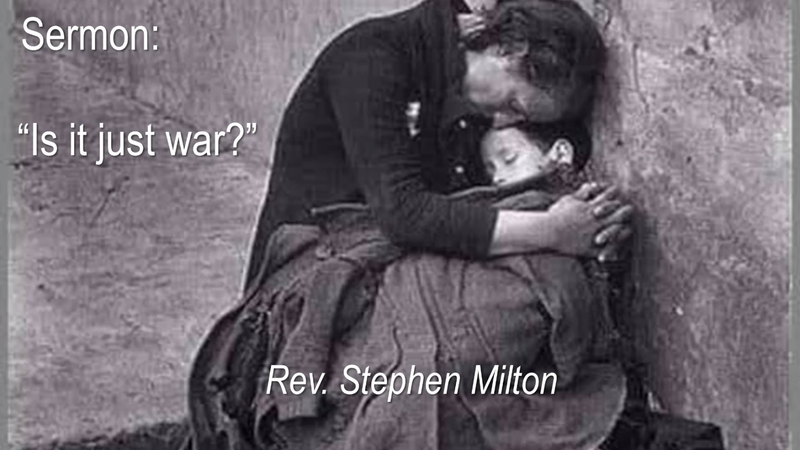
On Remembrance Day we remember the sacrifices of soldiers who fought in wars, or supported armies from behind the scenes. We do not formally honour the civilian casualties of war. Our ceremonies are for people who wear uniforms. Yet in Gaza, in Ukraine, in Iran, it is often civilians who suffer the most. To complicate matters further, the Americans and Israelis have been using AI to generate targets and conduct attacks. In today’s war, some of the most powerful “soldiers” aren’t people at all. And yet they make lethal decisions which can take the lives of human soldiers and civilians alike. War has changed.
Christianity has struggled for a long time with the practice of war. Jesus was a pacifist. On the night of his arrest, Peter tried to defend Jesus, slicing the ear off one of the men who had come to take Jesus away. He was admonished by Jesus ( Matthew 26:51-4). In Luke’s Gospel, Jesus heals the man’s ear on the spot (Luke 22:51). Jesus could have told his followers to arm themselves to fight back against the Romans. But he didn’t. Instead, he went to the cross, an act of non-violent resistance that changed the world.
In the centuries after, the Roman Catholic Church wrestled with the practice of warfare. The rich and powerful sought to co-opt the church, to reduce its aversion to war. And they succeeded. The Church supported wars, and even launched a few of its own, like the Crusades. Over time, the Church developed a concept of a just war. A war must be a last resort. If attacked, the harm done must be serious and lasting, so the risks are real. All other peaceful avenues must have been exhausted in good faith. There must be a serious prospect of success.
In Pope Leo’s recent Encyclical on Artificial Intelligence, The MAGNIFICA HUMANITAS, he devotes an entire chapter to war and peace. He carefully considers the conditions of modern warfare, and reaches a conclusion similar to General MacArthur back in 1945. Pope Leo states:
“ Today, more than ever, without prejudice to the right to self-defense in the strictest sense, it is important to reaffirm that the “just war”theory, which has all too often been used to justify any kind of war, is now outdated. Humanity possesses far more effective and capable tools for promoting human life and resolving conflicts, such as dialogue, diplomacy and forgiveness. “
The point of human civilization, the Pope argues, is to foster the well being of all human beings, regardless of race, wealth, ability or ethnicity. He calls this a civilization of love. Achieving it should always be society’s primary goal.
Yet our current leaders seem more interested in a civilization of war. Here in Canada, we are increasing our defence spending because America’s least popular President told us to. All over the world, countries are rearming - including Japan and Germany. Diplomatic efforts to head off wars before they begin have been undermined. The Americans and Israelis even chose to kill all of Iran’s leaders when they were frustrated by the slow pace of negotiations. This solved nothing.
In today’s parable, ten virgins await the arrival of a bridegroom so they may attend his wedding banquet. Jesus tells this story as a way of speaking about how his followers should behave before he comes back after his death, in the end times. The virgins fall asleep waiting for the groom, as the hours pass. When he finally comes, some have run out of oil in their lamps, while others still have enough. Those with enough oil are able to walk with him through the dark and enter the wedding banquet. The rest are locked out, even when they get some oil in town.
In the Gospels, a wedding is never just a wedding. It represents the joyous union of human beings with God, the ideal society, the ideal civilization, here on earth. Only Jesus can make it happen, he is the groom, and we are the guests, even the bride in some stories. But to get to this wonderful party, we must wait. And it matters how we wait. Will we shoot our way there, spilling each other’s blood, expecting to enter the wedding in blood stained clothes?
How we wait for Jesus matters. The way to prepare for the wedding, to be ready, with the right oil in our lamps, is to practice peaceful ways of living now. A peaceful way of living that can light the way as we walk through the darkness towards that wedding.
We can be realistic and admit that during our time, we will never get civilization exactly right. But we can try harder to be peaceful. We can place greater faith in institutions that encourage dialogue, even when we are not in a crisis. We can revive the dream of international peace that inspired the United Nations. We can pressure our governments to reduce the number of nuclear weapons on this planet. We can insist that there be a functional International Criminal Court that can put politicians on trial for war crimes. All of these measures are under attack now. But they don’t have to be.
We citizens can say that we want peace. We can talk to each other about how to get there, drawing on lessons of the past, and our theologies.
We should not underestimate the power of regular citizens. The midterm election in the United States this week showed that when citizens are fed up, they can change their minds, and change governments. We have that power. But we have to be clear about what we want. More peace, or more war? Do we believe that more shooting will create a greater peace? If not, let us learn how to make peace as we wait for the Prince of Peace. Let us use our time of waiting wisely, in anticipation of that great celebration to come. Let us make life now more like the wedding we hope to attend. Amen.