
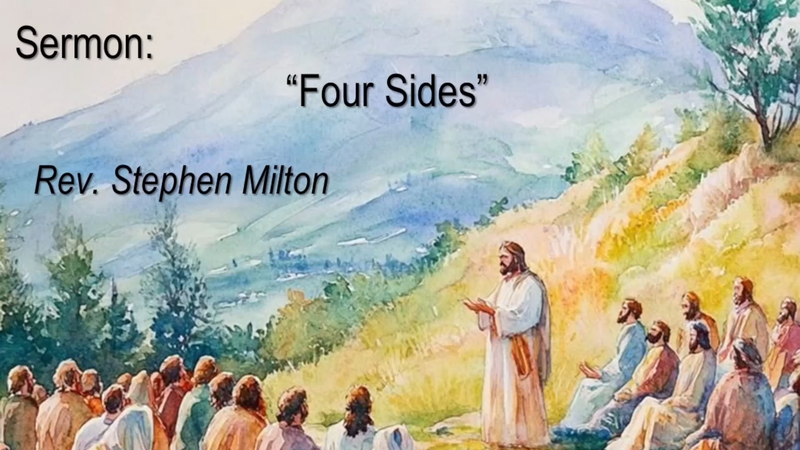
“Four Sides: Why do the Gospels Contradict Each other?”
Rev. Stephen Milton
Lawrence Park Community Church
January 18th 2026
Today’s scripture reading is from the Gospel of John. It picks up where we left off last week, with the baptism of Jesus. Filled with the Holy Spirit, Jesus goes out to gather up some disciples, men he can enlighten and count on to carry on his message after he dies. So, Jesus poaches some disciples from the people who have been following John the Baptist. John doesn’t seem to mind, since he has already declared that Jesus is the Messiah, the one everyone has been waiting for. John never claimed to be the lamb of God, but he can tell Jesus is the one. So he bears no ill feelings when Andrew joins Jesus.
But there is another version of this story. You may remember the scene:
Calling the fishermen
Jesus is walking along the shore on the Sea of Galilee. He sees two young men fishing - Andrew and Simon. He calls out to them with that famous line, “Come, I will make you fishers of men.” ( Mark 1:16-17; Matthew 4: 18-22)
They must sense that Jesus is a man of spiritual power, so they abandon their fishing, and come to join Jesus on the shore. That’s the way the story is told in the Gospel of Mark and Matthew. In Luke, this event comes much later, after Jesus has been preaching in many villages, and working miracles.
So, there are three versions of how Andrew and Simon Peter were called to be disciples. And they don’t agree. They can’t all be true. Yet, there they are in the gospels. The people who put together the Bible were just as smart as we are. They noticed that the gospels often disagreed substantially about what happened to Jesus. And not just small details, big ones. John disagrees with the other three gospels about the day Jesus died. He has it on the day before passover, not on Passover. In Mark, there are no resurrection scenes at all, the women find an empty tomb, and that’s it. In the other gospels, sometimes women discover the resurrected Jesus first, sometimes men do. The four gospels do not add up.
We know that each of the gospels was written in a different time and place. Each was originally part of a particular Christian community, who didn’t all have contact with each other. Each group had the same problem - how to take all the stories and memories about Jesus, and put them together in a coherent way. Matthew and Luke clearly read Mark’s gospel - they borrow alot, and add whole new sections. When the New Testament was collated in the 4th century, the most popular gospels were chosen, even though they disagreed on the details, and often big ones.
Early Christians believed that the number four was a symbol of wholeness and harmony. There are four winds, and four cardinal directions. In Eden, there were four rivers. But most telling of all, in the book of Ezekiel, the prophet had a vision of heaven, with its heavenly beings. Among them were the Cherubim, scary-looking creatures who moved in all directions. And unlike us, they had four faces.
Cherubim
One face looked like a man, one face looked like an eagle, one face looked like an ox, and one looked like a lion. (Ezekiel 1:10). Early Christians reasoned that they had four faces so they could see in every direction simultaneously, giving them full, perfect vision. They were not limited in their vision as we are here on Earth.
Seeing in all directions at once is how God sees, and so Christians believed the gospels were written to provide that same sense of a holistic vision. Four different perspectives on the same story, so it could be complete. They even used the faces of the cherubim to represent each Gospel writer:
Matthew Man
Matthew’s which emphasizes Christ’s humanity was represented by a man, who is seen floating by his side.
Mark Lion
Mark’s brief, action-packed version was represented by the lion.
Luke OX
Luke’s gospel focuses on how Jesus is like a priest for the human race. His icon was the ox, an animal that was often sacrificed at the temple.
John Eagle
And John’s more transcendent vision of Jesus is represented by the eagle. John’s gospel starts in heaven, with that prologue that in the beggining was the Word.
The early Christians believed that each gospel had its own perspective on Christ’s life, and those differences were marked by these icons. They did not expect the gospels to agree.
Early Christians believed that the multiple perspectives of the gospels provide a combined spiritual insight that was more valuable than factual consistency. Or, to put that another way, a truly spiritual life accepts different points of view, and expects them to coexist. God sees all the complexity of reality, and we are invited to do the same. Indeed, our ability to see another person’s point of view, even if it is at odds with our own, is part of the spiritual calling.
One of the downsides of our time is that we have lost this tolerance for multiple points of view. There are many causes of this. We can blame part of it on the Romans. Back in 325 the emperor Constantine convened a meeting of all the Christian churches from all over the mediterranean and north africa. He knew they didn’t all worship the same way and they had many views. Constantine had legalized Christianity, and would later be baptized. He was used to running an empire, so he didn’t want multiple perspectives, he wanted one clear set of views. Out of that meeting came the Nicene Creed, the very first Christian creed. It was like the executive summary of the faith, and it was expected to be recited by people who claimed to be Christians.
Now, I know we have people here in our congregation who come from many different branches of Christianity. How many of you had to memorize a creed or catechism at some point? Which ones? Right, there’s a whole bunch. This often happens as part of confirmation classes. Creeds and catechisms tend to iron out all the differences. I used to attend a church where we stood up and recited the United Church’s New Creed every week. Most of us had it memorized. I like that creed, but that’s because I agree with it. But if a person doesn’t agree with it in part or in whole, reciting a creed can be pretty uncomfortable, It just becomes a bunch of empty words. So, I haven’t been interested in doing that here. We recite the United Church New Creed every second time we celebrate communion, so that’s about four times a year. And if you don’t agree with it, don’t say it. You’re still welcome here. We’d rather have people who can see things from multiple points of view than just one.
Christianity’s influence on our culture has waned, but we still like to have one answer, rather than many answers and perspectives. Part of that is due to science. When we ask about the force of gravity on a building, we don’t want ten answers, we want one. A person’s perspective should have nothing to do with it. Will a bridge built with these materials stand or fall? It’s important that there’s just one right answer. We get cross when people offer up multiple perspectives to practical questions. When will the Eglinton LRT open? We don’t want five answers, we want a date that comes true. How long does it take the Finch LRT to go across the city? Again, we don’t want to hear about rain or snow, we just want an answer.
Governments often talk about the need for efficiency and they are willing to sacrifice public dialogue to get it. Here in Ontario, the provincial government has decided that controversial bills should be passed with as little debate and public consultation as possible. Where once bills would be taken on the road to communities for feedback from the public, that isn’t happening very much anymore. Bill 33 is the public education bill that gives the province to run schools much more directly than ever before. The government can take over a school board; it can tell universities what criteria they should use for admissions; it changed the rules so it is not schools but the police who decide when police officers can be in the halls - schools can’t say no.
Queen’s Park
This bill was barely debated. It didn’t go out to the public for discussion. On its third reading, each party was only given 36 minutes to discuss it before it was voted on.
This process assumes that government knows best, and that no other views count. But other perspectives do matter. They can point out shortcomings in a bill which the government has not anticipated. The press may find that the spa company Ontario signed a deal with has actually been in trouble in Europe, and is not what it seems.
Multiple perspectives matter, regardless of who is in power. We are stronger when we can see the same questions from multiple perspectives, not just one. This city has people from all over the world, our richness lies in that multiplicity in perspectives.
Punjabi
In music, Brampton and the GTA have been churning out pop stars who are huge in India, singing in Punjabi. They combine rap, hip hop and Indian pop music to make a new kind of sound which one billion Indian people are really into as well as people right here.
K pop Demon Hunters
Last year, the most watched movie on Netflix was K-Pop Demon Hunters. It was viewed over 500 million times worldwide.
It’s the story of a Kpop trio of singers who are megastars, but they are also really in charge of hunting demons.
Maggie Kang
It was created by Maggie Kang, who grew up in North York. Her family moved here from Korea when she was 5 years old. She went to Sheridan College’s animation program, and then worked on several Hollywood films.
When she was in a position to make one of her own, she wanted to combine her love of Kpop, Korean mythology, and the North American culture and styles she learnt here. She was able to make the biggest movie of the year not by sticking to one perspective, but by letting multiple perspectives combine to make something new.
The ability to see the world from multiple points of view is a strength, not a weakness. Our Christian ancestors understood this when they put the Bible together with four gospels that did not agree on the details of Jesus’ life. In the scripture reading we heard today, Jesus doesn’t meet his new disciples and start teaching them. Instead, his first statement is simply, “What are you looking for?” Jesus starts by inviting people to express their multiple perspectives. At a time when our culture increasingly claims that there is only one right answer, even in politics, we would do well to heed the wisdom of Christian ancestors. Multiple perspectives can coexist. Instead of telling people what they should think, we would better off really listening when we ask people “ what are you looking for?” Amen.

%20(4).png)