
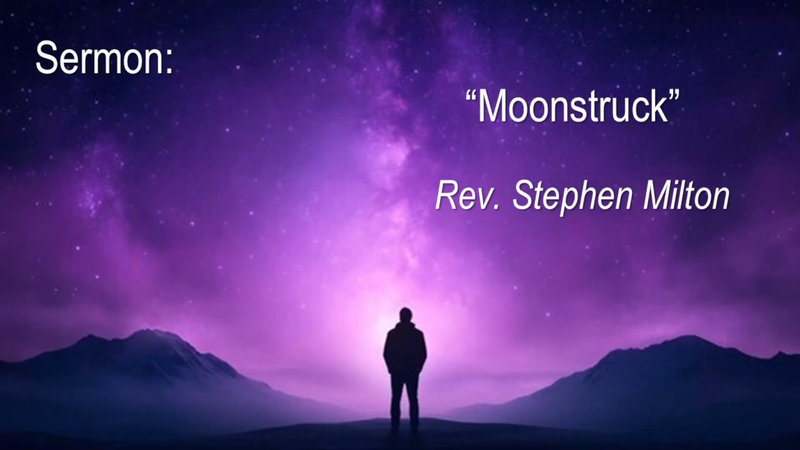
“Moonstruck”
Rev. Stephen Milton
Lawrence Park Community Church
February 15th, 2026
Today’s lectionary reading is the Transfiguration, that extraordinary vision of Jesus on the mountain top, glowing like the sun. In Protestant churches, this reading always appears on the Sunday before Lent begins. But the lectionary asks only to read the first half of what we heard today. I asked for you to hear the second half as well, because it is the punchline, the completion of the theological thought that begins on the mountain top.
The story begins with Jesus asking three of his disciples to join him on the top of a mountain. He chooses John, Peter and James, the three men who will be the leaders of the Jesus movement after Jesus is gone. This suggests that they are the most spiritually advanced and insightful of the 12 disciples. Going to the top of a mountain in most religions means getting away from everyday life, and getting closer to God. It is a “thin place” as Celtic people say. And sure enough, these three men see an extraordinary vision. Jesus glows bright white, as angels do in the New Testament. Jesus is seen with the two greatest heroes of the Hebrew Scriptures, Moses and Elijah. And finally, God’s voice announces that Jesus is God’s Beloved son, with whom God is well pleased. Listen to him!”
This seems to be too much for poor Peter, who says, let us build three booths or huts for these heavenly guests to stay in. This seems like proof that Peter is freaking out, and at a loss for what to do. But in fact, Peter is doing something that makes a lot of sense to a Jew of his time. Each year, the Jews celebrated the festival of booths, where they moved out of their homes to live in dwellings with grooves made of sticks. It is a deliberately rustic experience, meant to remind them of their years spent in the wilderness with Moses. However, the festival of booths also anticipates the coming of the Messiah, when it will be possible to simply lie around in ease under flowery bowers. When the Messiah makes things right, life will always be a sabbath day of rest and relaxation. And Jews have been told that before the Messiah arrives, Elijah will return.
Early Christians adopted this idea.
Bower
In the catacombs, they often painted this image of a man resting under a bower, as a sign that the blessed time of resurrection and rest had come.
Transfiguration
So, when Peter sees Moses, Elijah and Jesus all together, it looks like proof Jesus in the Messiah, so this would be a good time to build those booths. It doesn’t get any better than this, so they should just stay on the mountain top and bask in this blissful glory.
But Jesus has a different idea. He doesn’t want to stay on the mountain top. In fact, once the vision has ended, he doesn’t want them to tell anyone else about what they saw. Jesus is a modest Messiah in Matthew’s gospel, he has no interest in bragging about his divine nature.
Normally, that is where the lectionary reading stops. Jesus is divine, these three disciples know it as a fact now, and by extension, so do we. But that is not where the story stops in Matthew’s Gospel. He wants us to hear the second part about the boy, too.
Jesus comes down the mountain to meet a curious scene. The rest of the disciples have been trying to cure a young boy who suffers from seizures. His father tells Jesus that a demon has possessed the boy. The evil spirit regularly tries to kill him by throwing him into fire or water. The disciples have tried to cure him through faith healings, but with no success. Jesus is quite annoyed by this, accusing the disciples of having too little faith. So Jesus rebukes the demon, and when it is gone, the boy is instantly cured.
Why would Matthew pair this story with the transfiguration, which is so transcendent and beautiful? One of the keys to this story has to do with an old idea that gets lost in translation. Our scriptures tell us that the boy has epilepsy, a neurological disease that causes seizures. It is a condition which we treat with drugs. But in the original Greek of today’s scripture, the term for the boy’s condition is that he was “moonstruck.” His condition was believed to be caused by the influence of the moon’s rays. The moon obviously shines on everyone, so only some people were made unstable by the moon. In this boy’s case, a demon has made him susceptible to the seizures that come with being moonstruck.
Why should this matter, that Matthew uses the word moonstruck? In using this term, Matthew is setting up a parallel with what happened on the mountain. When Jesus starts to glow, we’re told that he shines like the sun. When the three disciples see this, and hear God’s voice, they fall to the ground. They are “sunstruck”, in contrast to the boy who was moonstruck. But there is a difference: the disciples are not thrown to the ground against their will. Instead, they fall to their knees out of awe and respect. They are filled with a divine energy that makes them weak, but also stronger than before. The boy, by contrast, is made weaker by a force he cannot control, and which may kill him.
Matthew’s gospel presents us with two contrasting states of being. The divine bliss of the mountain, where Peter wants to remain, and the demonic, moonstruck messiness of the world below. A place where people can lose their humanity through possession and disease, violence and prejudice. Jesus chooses to leave the bliss of the mountain top to share his divine power with the broken world, as represented by this moonstruck boy, literally subjected to the powers of darkness.
It is a question of balance. Throughout Christ’s ministry, we see him heal hundreds of people; he thrusts himself into the hurt of the world. But usually, after a major healing, Jesus withdraws to be alone, so he can rest and pray. Jesus moves back and forth between communing with God and helping people in the world. It is a dynamic balance, like breathing in and out. Both are needed, not just one.
Christians understand this balance, and when we get it right, we can do great things. It is no coincidence that so many schools and hospitals have been set up by Christians, often by monks and nuns. In Toronto, many of the hospitals were created by religious orders - St Michael’s hospital downtown and Saint Joseph’s in the west end were created by nuns, as was St John’s Rehab. The University of Toronto started out as several religious schools and seminaries, which slowly evolved into the university. Our entire public education system evolved out of Sunday school literacy classes in the 19th century, run by Protestant churches. At our best, the balance between prayer and action makes the world a better place.
But that balance can get lopsided. Christians can convince themselves that it is better to stay on the mountain top, where a select few get to be with Jesus. The chosen ones, the elite, the pure ones. Christians can tell themselves that everybody else is less pure, less important. They can shun the people who live at the bottom of the mountain where life is impure and messy.
This kind of unbalanced view is playing a role in the terrible events occurring in the United States now. The Trump government had enormous support from white Christians. They worked hard to get Trump elected, knowing that he promised to deport millions of illegal immigrants, mostly people of colour. Trump had told them that non-white migrants in America were “vermin” and rats, a threat to the purity of the nation. This is why ICE has targeted anyone who looks brown or Black, knowing full well that many of the people they arrest may be American citizens. To a government that believes in the purity of the white race, Black and brown people are a threat to those who want to stay on the mountain. To be pure. The racism of this government was in full view when the President shared a video portraying the Obamas as apes. The message was clear: whites are full humans, Blacks - even former Presidents - are less than human.
This kind of purity thinking is usually invisible to the people who promote it. They think they are just protecting their own people from objective threats, usually in the name of law and order, and security. They think they are staying close to God, making sure that a pure relationship with God is maintained. They are keeping the mountain top safe from what is down below. By stressing their own purity, other people, other human beings, come to be seen as impure and less than human.
I think we are witnessing a similar dynamic here in Toronto. A little over a year ago, the City of Toronto announced that it would be expanding the shelter system. 20 new shelters would be built, to accommodate the increasing population of people who live on the street. In a break from the past, these shelters will be spread out, appearing in residential neighbourhoods all over the city. This has inspired significant opposition. At one packed City meeting last summer, neighbourhood groups turned out to protest the plans, citing safety concerns. One group came wearing matching t-shirts that declared there should be no shelters in their ward. Residents argued that the shelters would bring crime and drugs into the neighbourhoods. Children would be at risk. Housing prices would dip. The City stood its ground, but the fight is not over yet. Neighbourhoods are lawyering up, trying to find ways to block shelters from being built.
There was a time when white neighbourhoods used similar tactics to block other kinds of people from moving in. They reacted this way to keep Blacks and Jews out of their neighbourhoods.
Real Estate
Real estate agents knew not to sell houses to Blacks in certain white neighbourhoods. They would direct Black buyers elsewhere or quote much higher prices for houses than for white buyers. White neighbourhoods liked to stay white. Social clubs had similar rules. Up the street from the church there is a sports club called the Granite Club.
Granite Club OHRC
It didn’t admit Jews until until 1970, and that was after it faced pressure from the Ontario Human Rights Commission, when it sought approval to move to its current location. There were many golf clubs and racket ball clubs who did the same.
Whites in this city used to try to keep their neighbourhoods “pure” .
That sort of discrimination is thoroughly illegal and unacceptable now, but we still treat the homeless in the same way. They are seen as a threat to the safety and purity of our neighbourhoods. They should stay downtown, in their unofficial ghettoes. We would rather see them sleeping on heating grates and on the subway than stay in shelters in residential neighbourhoods. They are seen as lazy drug addicts. It was just last year that the Premier of Ontario declared that homeless people should just get off their asses and find work. As though it was that easy.
As though finding affordable housing wasn’t the major problem.
Jesus knew that the world is filled with demons of hatred and cruelty, forces that can be obvious, but can also be secret and silent. He came down from the mountain to bring God’s power and compassion to those who are suffering. His first healing was of a boy whose behaviour was terrifying - a boy possessed, who was being thrown into the fire and into water. A boy who seemed to have lost his humanity, a person most people would have shunned, especially if he had been an adult.
Yet Jesus sees the humanity of this boy, and calls us to do the same. He is frustrated that his disciples have been unable to help the child. Jesus calls us to remember that everyone is human, even if they have nowhere to live, even if they smell bad or act strangely. We are called to help, not to shun those whose humanity has been hijacked or denied. This is not easy to do. But Jesus shows us the way: he heals the boy through prayer, reminding us of the balance. Drink in God’s light of compassion, then act in the world. Breathe in, breathe out. Love in, love out. Love in, love out. Love in, love out. Amen.

%20(4).png)