
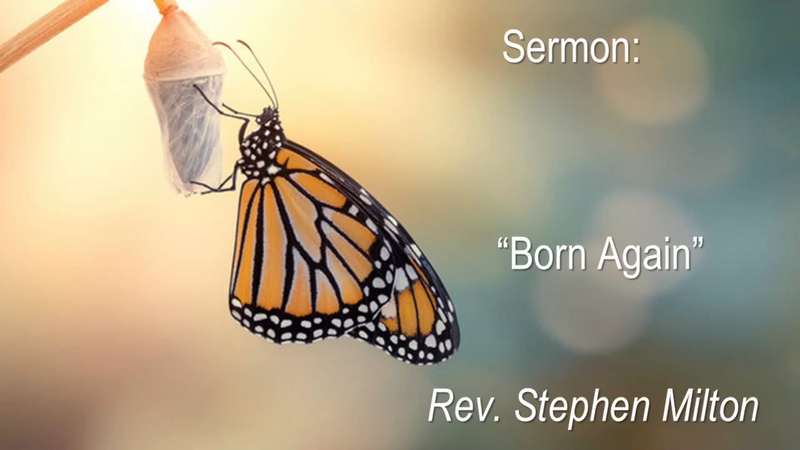
“Born Again”
Rev. Stephen Milton
Lawrence Park Community Church
March 1st, 2026
Today’s scripture reading comes from the Gospel of John. Jesus has been making a name for himself. He has turned water into wine at a wedding. In Jerusalem, he has flipped the tables of the money changers, getting the attention of the Temple officials. Most of them are annoyed, but one of them is impressed. He can sense that this young man from Galilee has a close connection to God. But fearing that being seen with Jesus could be risky, he appears at night for a secret meeting.
Nicodemus is part of the Jewish Council that runs religious affairs in Jerusalem. He has power and influence. So, Jesus should be impressed by such a high ranking visitor. But, instead, Jesus speaks with authority and chides Nicodemus for not understanding the ways of God better. Jesus tells Nicodemus that anyone who wants to be a true follower of God must go through a dramatic change. They need to be born of the water and Spirit. In the Greek there is a phrase which can be understood in two ways. One way is that to follow God, you must be born from above. The other way of understanding it is that you must be born again. (John 3:3)
That’s the meaning Nicodemus gloms onto. He is shocked and perplexed. How can a person re-enter their mother’s womb? Nicodemus has just met Jesus, he doesn’t realize that Jesus talks about spiritual matters in metaphors. But Nicodemus’ literalism underlines Jesus’ point. In this life, Jesus is saying, you need to make a choice. Are you just going to keep living your life like everyone else, living according to the desires of the flesh, or will you choose to follow God, to be remade through the water and the spirit?
That reference to water and spirit is telling. John is writing this Gospel for Christians who are living around the year 90. It is likely all of them have been baptized as adults. Back then, they liked to baptize people in rivers, like Jesus was baptized in the Jordan. Ideally, the water was to be deep enough to drown in. That wasn’t a macabre death wish. Rather, it was a recognition that when pagans gave up their old life of worshipping pagan gods, they were dying to their old life, and being reborn to a new life filled with God’s spirit. They had become new people in Christ. This would be chapter two in their lives, and it would be a choice.
This meeting between Nicodemus and Jesus is famous for many reasons, but primarily because it gives us that phrase “ born again.” Many Protestant Christians in places like the United States and Canada believe that through baptism they have been born again, and it has become a label we attach to evangelical Christians, especially those in the Baptist denomination. So, this idea of having two identities in life, one before and one after this spiritual initiation, has become equated with Christianity.
But this idea is bigger than Christianity. It appears in stories that have no obvious Christian content at all. You know some of these stories because you heard them as children. In fairy tales, there are many stories where a person appears to have one identity, but they are really someone else. The girl who meets the frog by the pond, who begs her to kiss him. She resists, because kissing frogs is just gross. But when she finally relents, it turns out he is not a slimy old frog, but a handsome prince. In the Beauty and the Beast story, it is the same idea. The scary Beast whom Belle must marry is actually a prince who has been cursed. Her love will bring him back to his real identity.
Often in these stories, the hero has no idea who he is.
King Arthur
The King Arthur story is like this. Arthur grows up thinking he is a nobody, when in fact he is a king’s son, adopted by a family who hides his true identity from him. It is only when he pulls the sword from the stone that he starts to realize he is meant to be the King who will rescue England.
This forgotten identity story keeps showing up in our times, too.
Harry Potter
Harry Potter has no idea how important he is when he is growing up, and his adopted family keeps the truth from him. Eventually he learns he is the one who must defeat the evil wizard Voldemort.
Luke Skywalker
Luke Skywalker grows up not knowing that he is the son of Darth Vader, and that he is filled with the force.
Jason Bourne
In action movies, Jason Bourne is a CIA super assassin who forgets his true identity when he bumps his head in an accident.
This plot shows up often in TV soap operas, too, where a kind person shows up suffering from amnesia, and slowly regains their memory.
This fair tale storyline just won’t go away. We are fascinated by people who are more important than they seem, who have a greater destiny than the life they are leading now. But why are these stories so interesting that we want to hear them again and again?
Bruno Bettelheim was a 20th century psychologist, and he had a very interesting theory about why children are so captivated by fairy tales. He argued that every fairy tale can be read as a story about the human psyche. Every fairy tale is really about you. You are every character, the witch, the hero, the frog, the clueless peasant.
Using this logic, we are fascinated by the person who forgets their true identity because that is our story, too. Each of us is capable of becoming more psychologically integrated, more together, to realize a higher state of identity. To become a king or queen in our own life. Not by becoming rich and powerful. What Bettelheim meant was that each of us has the potential to finally pull all the parts of our personality together so we can become more whole, less worried and anxious, more at peace with ourselves. We can become whole. And that potential is why we love stories about people who forget who they are, but then, by the end, finally remember.
But how do we get to that fully realized state? Modern society suggests therapy. Often, what holds us back from feeling fully integrated are past traumas and experiences which we have never fully confronted emotionally. Many of these can stem from childhood, but not always. We often build up defences within ourselves to deal with angry or uncaring parents, or traumatic experiences. Those defences help us get through the rough patch. But they can become engrained, and become dysfunctional later on when circumstances change. Confronting old traumas and conflicts, some of them forgotten, can help us move on, and integrate these different parts of our personality.
This approach can work wonders, but it doesn’t mean that we live happily ever after, like in the fairy tales. “Happier ever after” might be more accurate.
But, even this approach will not necessarily lead to a connection with God. Getting over past difficulties, even if just a few of them, may make us feel better, but we can do this without even wanting to get closer to God.
But some people do want that spiritual connection. Like all four of the people who were baptized today. You have explicitly stated you want to have a richer life, one imbued with God’s spirit, and with the blessings of being in a church community. You want to start chapter 2 in your life, from what you were to who you could be, walking with God. Christians would argue that this second self is who you were always meant to be, a more fulfilled self. But what will that relationship with God be like? Will you be filled with the spirit now and always feel God’s presence?
That can happen. There are lots of people who have been baptized as adults who have had periods when they could feel God’s presence daily. It’s a wonderful experience, life feels more meaningful and more enchanted. Like there is a purpose and structure within life that was hidden before.
But I would be dishonest if I claimed that this is how everyone feels. Many of Christianity’s greatest mystics have reported times when they felt very close to God, a real kind of spiritual high. They have devoted their life to God, becoming monks and nuns, or priests and ministers. And then…. The feeling has worn off. That high of feeling God’s presence all the time goes away. Sometimes all at once, sometimes gradually. Richard Rohr, the American mystic has written about this. In his book, The Universal Christ, he writes:
I must be honest with you here about my own life. For the last ten years I have had little spiritual “feeling,” neither consolation nor desolation. Most days, I’ve had to simply choose to believe, to love, and to trust. The simple kindness and gratitude of good people produces a momentary “good feeling” in me, but even this goodness I do not know how to hold on to. It slides off my consciousness like that cheese on a Teflon pan!
This feeling occurs often among religious people. Mother Teresa experienced it, so did St John of the Cross, who famously spoke about the “dark night of the soul.” The truth is, our sense of God’s presence is not constant. It comes and goes.
So does this mean that we have been deceived about faith? That Christianity has been lying to us? No. This is simply part of the spiritual life, and has been for a long time. God is always with you, but you can lose the feeling from time to time. And then it can come back.
On that night when Nicodemus visited Jesus, he was told this, but he may not have understood it right away. Jesus spoke about God’s presence in terms of the holy spirit. He compared it to the wind:
The wind blows wherever it pleases. You hear its sound, but you cannot tell where it comes from or where it is going. So it is with everyone born of the Spirit.
In Greek, the word for spirit is the same as the word for wind, or breath. Our experience of the holy spirit is unpredictable, it is like the wind that comes and goes. It seems to have its own agenda. Even Jesus experienced this. When he was on the cross, he lost the feeling of God’s presence. He cried out, “My God, my God, why have you forsaken me?” ( Matthew 27:46).
But of course, God did not forsake Jesus. He was resurrected. In his great pain, Jesus lost that feeling of the spirit, like a wind that had blown strong at sea, and then disappeared, creating a dead calm.
So, how do we are Christians keep our connection to God if the feeling can come and go like the wind? Jesus points the way there, too. His lines from the cross come from the first lines of psalm 22. In that psalm, the singer begins feeling forsaken, but as the psalm continues, he praises God, remembering all the great things God has done. He imagines being in the temple, singing God’s praises to all. Jesus knows, even from the cross, feeling no presence of God, that it will come back. And it can be felt in community, when surrounded by others who also experience the spirit, sometimes strongly, other times weakly.
This is why Christianity is a religion that is best practiced in groups. We won’t always feel God’s presence on our own. That feeling of the spirit comes and goes. But you can be reminded, and refilled by being among others who are feeling it. By singing hymns that contain the spirit. By being fed by the spirit in communion. By being in a building whose very walls and glass have held the spirit for so long.
So, to you who have been baptized today with the spirit, welcome to the second chapter of your life. You have started out on an adventure like King Arthur, to discover who you can be living a life dancing with God, listening for that tune. You will find it in your heart, in church, in scripture, in prayer. Like the wind, it will not always be in the same place at once. Welcome to the mystery and blessing of a life with God, where you can be a force for good - in your life and in the world. Amen.

%20(4).png)