
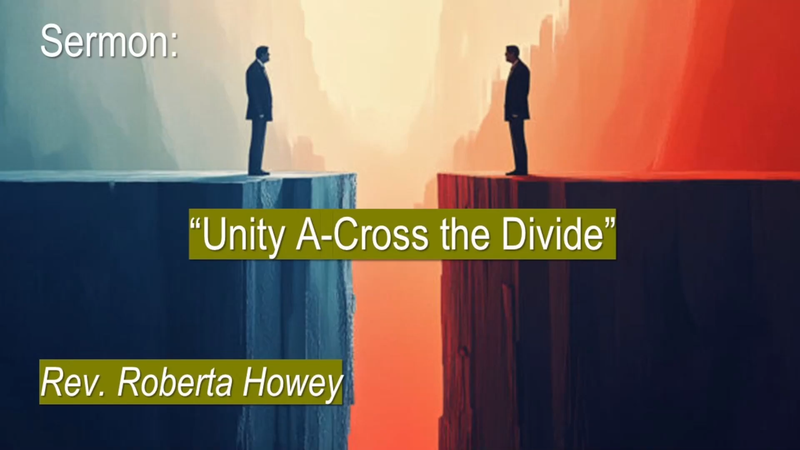
“Unity A-Cross the Divide”
Rev. Roberta Howey
Lawrence Park Community Church
January 25, 2026
1 Corinthians 1:10-18
Last week Stephen shared a sermon that explored the importance of people across beliefs and backgrounds working together to make the world a better place. I would like to expand on that this week. After all, wanting to work together is one thing, but how do we do it? How do we work with our neighbours and fellow Christians when we also know the long history of Christians not getting along with each other, let alone others?
As we can tell from Paul’s letter to the church in Corinth, this is not a new problem. Even as churches were just starting, there were already divisions brewing. Do you follow Paul, or Apollos, or Cephas? Do you worship with this household, or that one? This is human nature to create in-groups and out-groups, it is a part of us wanting to find ways to relate to others. We are designed to look for similarities and differences, and sometimes to rank them in order of quality or importance. I am born and raised in Scarborough, so when I hear someone else was, it creates another kinship bond, however thin, between two strangers.
The opposite is true as well. We want to know we are doing the things correctly. And if someone is doing something differently, is it better or worse than our practices? What if what they are doing is better than our own practices, and we need to change? No, it is better to decide we are correct. To say we follow the correct leader and do the correct movements and share the correct lessons. Throw in that for many Christians, the stakes are incredibly high (we are talking about the salvation of the world!) and suddenly those differences are dangerous chasms.
Fast forward through centuries of theological debates, religious schisms and church politics, missionaries recruiting people through all coercion or capital, and now we have Christian churches across the world. The World Council of Churches was still in its formation, postponed by WWII. In 1944, 10 Canadian denominations gathered at Yorkminster Baptist Church to talk about how the devastation of the war could be either healed or further expanded by the church. And is it possible for these very different 10 churches to share common goals of peace and justice, while remaining distinct? The Canadian Council of Churches was formed, created by denominations that by any regards, are complete opposites. You have your Baptists, your Evangelicals, your Presbyterians, your Society of Friends (the Quakers), the Disciples of Christ, and the Salvation Army. Just a wide array of groups that came together over three days to forge a new council of churches. The Rev. Dr. William Gallagher of the UCC was their first General Secretary.
From the General Secretary Report in 1954
“The Council has no legislative or administrative authority over the Churches or power to limit their autonomy in any way. Its objects are to give expression to the fundamental unity of the Christian Communions; to provide an agency for conference, common planning, and co-operative action; and to maintain relations with other Councils of Churches and to promote the Ecumenical Movement.”
While it started with domestic concerns like gambling and divorce, it quickly expanded to larger social issues like poverty, housing, pressuring politicians to care for the disenfranchised, and peace activism.
Several Orthodox churches joined in the 1950’s, which remember was during a period when Eastern European powers like the USSR were under heavy scrutiny here in the West. It was also one of the few organizations where women were able to exercise their authority as members of churches that did not allow women in the pulpit. The Catholic Church joined in later decades, along with many more churches that I simply do not have the time to name.
The Week of Prayer for Christian Unity (WPCU) is over a hundred years old. It started in the early 1900’s, as an 8-day series for churches across the world to pray together. Since 1968, the World Council of Churches took on the role of coordinating International communities and distributing materials. Each year, a different country creates the materials, including the worship service and theme. In the Canadian Council of Churches, we take the materials and adapt them for our context. We encourage churches to work with other denominations for joint services, Bible Studies, projects, and other ways we can pray for unity.
But what does that unity look like? It is not us being clones of each other. I love my Catholic siblings but they would not like me in their pulpit. Nor do I think a preacher from an Evangelical church would find it easy to be here. We differ in so many theologies! Communion, ordination, worship and music. One of the few things we agree on is that our baptisms are all valid but that took literal decades of negotiation.
We are brought back to the table. This is not the table of the UCC, or of LPCC. Our friends are not observing the Eucharist at the table of the Catholics, or the Presbyterians. We all observe communion at Christ’s table.
For all who are baptised, we are baptised in the name of the Father, the Son, and the Holy Spirit. One parent who unites us all. Not to be the same, but to celebrate that because of our differences we create one Body of the Church. I am not liberated by the United Church of Canada, I am liberated from death through Jesus. The UCC is simply where my calling leads me.
We follow Christ, whether in our sacraments, in his teachings, or in the spirit that fills our bones. It is this Spirit that moves people across churches to march, and to pray, for justice.
Minnesota clergy
Over a hundred clergy across multiple denominations were arrested in Minnesota last week, protesting ICE and their heinous kidnappings of civilians. I will not sugarcoat it. In the Episcopal Church of the US, the Bishop of New Hampshire warned clergy to get their affairs in order as they will be expecting arrests and consequences. Denominations large and small are looking at the rise of Christian nationalism, the rise of a mutated and corrupted facade of Christ who declares might is right, and are stating “absolutely not”, We do not follow greed. We do not follow apathy. We do not follow fascism. We follow Christ, who led us right here.
This is also true in Canada, where organizations like the Canadian Council of Churches have encouraged churches across the country to get together and work for peace. Whether it is large political statements, or simply a rag tag group organized to put together lunches in our local Baptist Church.
Churches can put aside their massive theological differences when we need to see Jesus in front of us and follow him. We will save the nuances and debates for another day- we don’t ignore, just prioritize. Right now, we are here, demanding justice.
Divided and isolated, we struggle under the weight of tyranny. But together, miracles happen, as we follow the one who calls us here.
Amen.

%20(4).png)