Today is called Reign of Christ Sunday. But it wasn’t always called that. How we got here is an interesting story.
This Sunday was originally called The Feast of Christ the King. It was created back in 1925 by Pope Pius XI. 1925 was an interesting year. The First World War had ended back in 1918, and the economy was booming in Canada and the United States. It was the flapper era, the time of partying and short skirts.
It was also a time when a few very rich men were getting richer all the time. Ford, Rockefeller, J.P. Morgan - financiers and industrialists were household names. Like today, wealth was increasingly concentrated at the top. This was the decade when the press first started to talk about billionaires.
But not all countries were doing so well. Germany was still trying to recover from World War 1. It’s economy was in tatters. Resentment ran high. A young man named Adolph Hitler was the leader of the Nazi party, and in 1925 he published the first part of his notorious manifesto, Mein Kampf.
Mussolini
In Italy, 1925 was also the year when Benito Mussolini declared that he was taking over Italy as dictator. He was the head of Italy’s National Fascist party. Italy stopped being a democracy, and instead, Italians were encouraged to regard Mussolini like a father figure who answered to no one.
Not everyone was happy about this. In Rome, the Pope looked out at what was happening with great concern. Society looked like it was going backwards. The Fascists promoted a kind of worship of their leaders. They were revered as men’s men who would stamp out weakness wherever they found it in the name of the purity of the nation.
Pope Pius XI
In 1925, Pope Pius XI released a statement, called an encyclical, where he argued that society was losing its way.
Societies were acting as though they could make up their own morals and values, banishing the values of Christ from government and society.
The Pope declared the result was a threat to peace among nations and between people. He saw all sorts of problems including
“those bitter enmities and rivalries between nations, which still hinder so much the cause of peace; insatiable greed which is so often hidden under a pretence of public spirit and patriotism, and gives rise to so many private quarrels; a blind and immoderate selfishness, making men seek nothing but their own comfort and advantage, and measure everything by these…”
To counter this, the Pope declared a new feast that year, one that celebrated the source of all moral authority, Christ the King. It was a deliberate rebuke to the Mussolinis and Hitlers of the world. It was reminder that the true governor of the world is not the local dictators who thought they were absolute rulers, but God and Christ.
Now, we know what happened next. Hitler did not stop. Neither did Mussolini. They ignored the Pope’s words and this new feast. They used the media and giant rallies to promote their rule over the masses. They asked their people to worship them and their governments. Declaring a Feast of Christ the King did not do much to slow them down.
And to our ears, this whole approach sounds like it was always doomed to fail. One of the great breakthroughs of modern government has been its ability to separate church from state. We are very suspicious of any state that wants to shove religion down people’s throats. That’s what the Taliban in Afghanistan do. It is not what we want here in the West.
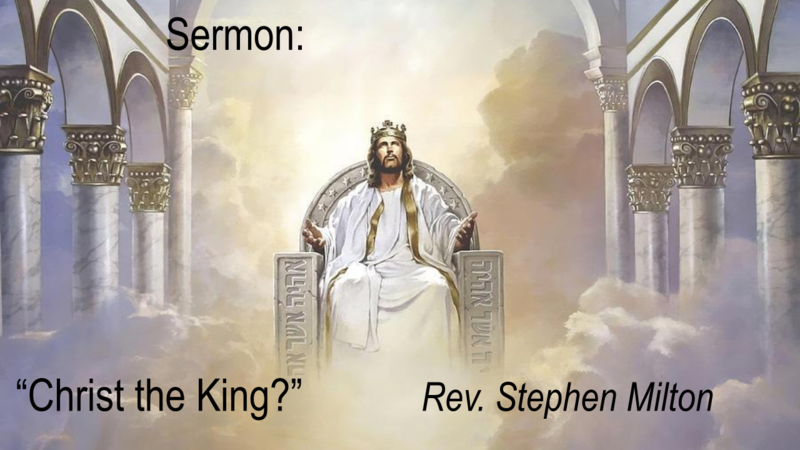
But the Pope was making a different kind of point. He was arguing that the source of our values for a just society do not come from us, but from God. His argument echoes something that Paul says in today’s scripture reading. In his letters to the Ephesians, he tells them that Jesus of Nazareth has been elevated to sit at God’s right hand. This is a clear reference to sitting next to God who sits on a throne in heaven. From this spot, Jesus has power over all human beings:
…. God raised Christ from the dead and seated him at his right hand in the heavenly realms, far above all rule and authority, power and dominion, and every name that is invoked, not only in the present age but also in the one to come. ( Ephesians 1:20-1)
Jesus is above every kind of rule and authority - above every king, every emperor, every dictator, every prime minister and president.
But if Christ is the King of the world, it is hard to tell. There is injustice everywhere, in wars, in people living in refugee camps, in the homeless on our streets. In the lack of clean water on reserves. There are so many ways in which life is not just nor fair. So how can Christ be the king if injustice and cruelty are so rampant?
The answer is that Christ is different than regular kings or rulers. They exercise their authority through laws, by telling people what they can or cannot do. They use the threat of force and jail time to keep people in line. You don’t have to agree with human rulers, but you do have to obey. Inner obedience is not required, only outer obedience.
But Christ has a different kind of royal rule in mind. In the scriptures, he tells his disciples that the kingdom of God is inside of them. When Jesus was arrested by the Romans, he was brought before the governor Pontius Pilate. He asked Jesus if he is the king of the Jews. Jesus replies:
“‘My kingdom is not from this world. If my kingdom were from this world, my followers would be fighting to keep me from being handed over to the authorities. But as it is, my kingdom is not from here.’ 37 Pilate asked him, ‘So you are a king?’ Jesus answered, ‘You say that I am a king. For this I was born, and for this I came into the world, to testify to the truth. Everyone who belongs to the truth listens to my voice.’ ( John 18)
Christ’s kingdom is not a bureaucratic one, but a spiritual one. He rules not by imposing laws on us, but by seeking to light a fire of compassion and fairness in our hearts. In today’s scripture reading, Paul tells his fellow Christians to see with “the eyes of the heart.” That’s what Jesus offers us. Membership in a kingdom that is of the heart. It starts in inside us, where our feelings, will and intention lies. And then it moves outward to change the world in a way that is consistent with Christ’s call for compassion and justice in the world.
This may all sound very theological, but consider this question: what is the point of our society? What are we aiming for? Ask most politicians in Canada and their answer is that we should have a strong economy. But how do we know whether a strong economy is a good economy? It can’t be as simple as how the stock market is doing. Up until a few weeks ago, the stock market was in great shape even while food bank use is at an all time high. The stock market has been doing great as large tech companies invest in data centres that are bad for the environment, using up massive amounts of water and electricity. Is a strong economy the same as a good economy?
And who decides whether it is good? The billionaires will tell us a good economy is one where they get rich, they are too self interested to give an honest answer. They will even ask for a trillion dollars for a product they say could kill us all, as Anthropic did this week with its IPO. The politicians will say anything they think will get them re-elected. They are too self interested to tell the whole truth, too. We need a standard of the good that stands above those who are in power and who have vested interests. A standard that is above all human influence, and yet at the same time speaks in favour of the welfare of all human beings.
That’s what Paul is talking about when he says that Christ stands above all rulers, powers and principalities. Above all billionaires, presidents, tech bros and dictators. We need a standard that starts with the idea that everyone matters, from the poorest to the richest, from the weakest to the most powerful. A standard that insists that everyone has to benefit and flourish if a system is to be deemed successful. That was what Jesus taught during his ministry. It is what we hear in the scriptures. It is what we still need to hear.
So, back in 1925, when fascist dictators were on the rise, the church created a feast dedicated to a king who stood above it all, calling for love and justice for all humans on earth. A few decades later, the name of the feast was changed to the Reign of Christ, and Protestant churches joined in. The date was moved to this Sunday, the last one before the Christmas season begins.
On this Sunday we recognize the reign of Christ in heaven, over all human hearts. We proclaim Jesus the ultimate source of all values of justice and compassion, a king in heaven. We proclaim this one week before Advent begins, that season of waiting for the king to be born on Earth. A king who will choose to be born among the poor, homeless, and alone. A birth that will be celebrated in the heavens as the birth of a king on earth. One destined for heaven. One whose message can change our hearts, and through us, change the world. So, let us embrace the message of this king, and let it reign in our hearts. Amen.