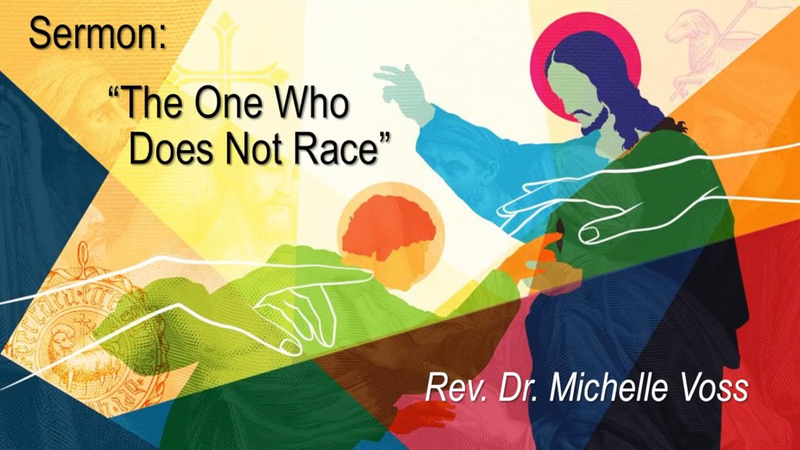
The One Who Does Not Race
Michelle Voss
It didn’t take long for Christians to start racing to the top. It didn’t take long for the disciples to stake their claims to authority. Even in today’s account of the resurrection, we see the evidence of Christians trying to one-up one another.
This passage from the Gospel of John was written around the year 90 or 100 of the common era. That’s about 60 years after the events it records. It shows how the early church narrated its beginnings, which mattered for the status of the various communities that were forming in different cities and with different leadership.
It’s important to know, for tracking this race, that the “disciple Jesus loved” is the name the author of the gospel of John gives himself. John starts the resurrection story with a race between Peter and himself, the beloved disciple. So let’s keep score. Who got to the tomb first? (The beloved disciple.) Who just looked inside, and who went in? (Peter went in, a point to Peter.) Who first believed that the Master had risen from the dead? (That point goes to the beloved disciple.)
This Easter morning pissing contest reflects a battle for authority in the early church: Peter, or John? Peter, the Rock upon whom Christ would build his church, whose church in Rome and would become the Roman Catholic Church? Or John, whose church was based in Ephesus, which would become the Eastern Orthodox church. The race for leadership in the early church was on. So far, the score is 2 to 1. John takes the lead.
But someone else is there as well. A woman, who found the tomb empty. She ran home to the men to let the men take it from there, as the story seems to go. And they left the tomb, she stayed, just weeping in the garden.
[MARY LEADING DISCIPLES] So someone else was there, the first to witness the empty tomb, the first to proclaim it, and the first to encounter the risen Christ. By my count, that puts her ahead of John, 3 to 2. She was the original messenger, the apostle to the apostles.
Yet we have heard of no major branch of Christianity that she leads. So how do we talk about this woman who doesn’t race around on Easter morning?
[MARY HE IS RISEN Before she was apostle to the apostles, she was the one who stayed. While Peter sat at the fire on that horrible night and denied any association with Jesus, she and the other women remained. These other steadfast women prepared the teacher’s body for burial. They are the ones who followed Jesus, no matter what.
So yes, someone else stayed there, inquiring where the Lord is. She becomes the first theologian of the resurrection. As she remains with the empty tomb, gazing at it through eyes clouded by grief and confusion, her faith seeks understanding. She keeps asking, “where?” Like her ancestor Jacob, who was Jesus’s ancestor too, she wrestles with the angel and will not let go without a blessing. She remains long enough to encounter the risen Christ. She stays until she hears him speak her name: “Mary.”
[ORANS WOMAN] Vanderbilt divinity student Beth Maczka curated a new art exhibit on Mary Magdalene this year. She explains that art history evidence from the early catacombs show a woman with her arms raised. She is often simply labeled, “woman in orans posture.” Orans, meaning to pray. Museum exhibits explain that this figure might be the deceased, or maybe a personification of the church. By contrast, the men who bear this posture have their names in the art historical record: Daniel in the Lion’s Den, Noah after the flood, Jonah in the whale, the three youths in the fiery furnace. As Maczka observes, “Men had names and stories.”
And yet, this woman with something to say was everywhere. Her image is much earlier than the crucifix, which became popular after Christianity was no longer a persecuted minority but had become the religion of emperors. The most common scene painted in the early catacombs was not a scene of death, but of life: the garden of paradise. And what better image to / grace a / crypt / than she who heralds the resurrection of the dead, who proclaims that we will be raised in justice and glory at the last days?
She is unnamed, but we are coming to remember her: Mary Magdalene, apostle to the apostles, the one who does not race, theologian of the resurrection.
Not only was she not in the race, but the tradition dishonored her, demoted her, and even in some cases removed her from the gospel record. The church styled her as a repentant prostitute, and not the apostle and leader of the church that she was.
[LA UNCION] You can see this demotion happening in Bible itself. There is a passage in Matthew and Mark, in which a woman / anoints Jesus’s head / with oil. Now you know the word Christ is not Jesus’ last name, right? Christ means Messiah, or “anointed one.” When she anoints him, this woman exercises the role of a priest. She recognizes Jesus for who he is, God’s messiah, and Jesus says, “From now on, the whole world will speak of this in memory of her.” But the whole world didn’t. People didn’t even remember her name. When they remembered the anointing passages at all, it’s the version in Luke and John, in which a woman anoints Jesus’ feet. In Luke, this person is called “a woman who lived a sinful life.” John names her Mary Magdalene. John puts Mary at Jesus’s feet, removing her priestly role. She is often painted under a table, sometimes with a bare breast to show her as a prostitute. Not a priest.
Maczka found many images of the anointing of Jesus’ feet, and almost none of Mary anointing his head. She wanted to see an image of this, so she commissioned Cuban artist Lázaro Ceballos Fernandez to paint one. They did this in memory of her.
But in the early church, Mary was a formidable presence. For centuries, biblical interpreters have assumed that “Magdalene” meant that she was from a place called Magdala, but this place did not exist in Palestine until much later. Recent scholarship has determined that this is her name (unlike Jesus, she seems to have had a last name): Mary Magdalene. Magdalene, meaning Tower. While Peter (petros) was the Rock of the Church, Mary was the Tower. She was a leader of the early church. A pillar of its witness. Apostle to the apostles. And she’s largely been erased.
I can only wonder what other kind of church we could have inherited. An alternative to the church that became aligned with the powers of this world, symbolized by Saint Peter in Rome—but equally present in Protestant churches like the United Church of Canada, which was created once upon a time to be the soul of the nation. What if the race to the top had not claimed the soul of the church? What might we know today that imperial Christianity forgot?
I suggest we can learn three things.
[MARY LEADING DISCIPLES] One thing we might know quite certainly is the good news that women have always been pillars of the church. The apostle to the apostles is one whose authority didn’t make much sense to the patriarchy. In fact, Mary’s authority as apostle to the apostles had to be diminished: she isn’t counted among the boy’s club of the Twelve Disciples.
She reminds me of other audacious women, trans people, people who love differently, and people whose race or economic status don’t quite fit in congregations. We consider ourselves nice Christians because we include them. If you’ve been getting the message that the church is only tolerating you, I suggest you keep your eyes on Mary the tower, and remember that the least likely candidates are the ones who inherit Jesus’s upside-down kin-dom, which is the antithesis of worldly power. That’s the first piece of these good news of Mary, apostle to the apostles. When I see signs of new life in the United Church, it is in dynamic emerging leaders like you.
[MARY HE IS RISEN] The second gospel message of Mary is that God, the Holy Spirit, is, like her, the one who remains. When Love had died on the cross on Good Friday, Mary and the other women did not abandon love. They found that the Spirit of God remains when the night is darkest, in that space between death and life, when there is no guarantee that Easter is on its way.
God waits with us as we hold our breath from week to week, waiting to see if the ceasefire will hold, if the threatened annihilation of an entire civilization, or some other Trumpian apocalypse, will in fact come about.
God’s spirit remains in Indigenous peoples, who steadfastly remain on the land of their ancestors amid genocidal conditions. God stays with the almost-extinct church in Gaza, where only around 5 to 600 Christians remain after everyone else has been displaced, relocated, or killed. God remains in the space between the medical tests and the diagnosis, and God stays at the bedside of your beloved who is dying.
It makes a difference that God is there in the in-between spaces. This presence that Mary embodied in is good news. It means that we are not alone. It means that God has experienced every valley and every shadow that we will encounter. Their presence doesn’t promise quick fixes or clean outcomes, but it does mean that we are held in the arms of Love. And not just love in the abstract, but Love that speaks our name, that comes to us in a way that we can hear it if we wait.
[ORANS WOMAN] The third gospel message that Mary proclaims to us is the resurrection. When she stands outside the empty tomb and asks where Christ is, she hears her name: “Mary.” She keeps on asking where he is, so you’re in good company if you have been through something hell, and you can’t comprehend, you can’t get your mind around, how life could ever be good again. There are signs right in front of you that Love is stronger than death. The tomb is empty. You’ve even seen angels in there, folding up grave clothes. But the message takes a while to register.
If you’re tempted to put those grave clothes back on because they have grown so familiar, the Holy Spirit will wait for you. Resurrection doesn’t look like what we think it will. It’s not a race to the top, where we are assured of our special status in God’s eyes (no offense to the Beloved Disciple). It’s also not an empire (sorry Peter). Instead, it’s always just breaking through in the garden, crocus-like. It whispers to us, and it calls us by name.
Where is resurrection breaking through? Have you seen it? Even just out of the corner of your eye?
The warmer days promise sunshine on our face. Maybe you’ll notice a brighter mood, perhaps. Or friend showings up while we cry—and then keeps showing up when we stop crying so much. Perhaps we let our guard down and have an authentic moment with our marriage partner, whom we have stopped really seeing a long time ago. Or a new volunteer opportunity, hobby, or a project at work awakens / creativity that had gone dormant. Or we come to church and hear a word that we needed to hear.
None of these glimpses of resurrection is insignificant. They kindle hope, and hope is called a theological virtue. God’s waiting, resurrecting spirit is calling us to witness to hope. Proclaiming the resurrection can be as simple as pointing out the signs of hope in the world, and awakening hope in others. It’s not a race, but the steady practice of looking for God’s presence and listening for Jesus’s voice. Can you commit to hope, one day and one moment at a time? Can you open yourself to the livingness of this garden? Can you open yourself once again to hear Love speaking your name?
In the name of the God who does not race, let us proclaim the resurrection, even while we wait. Amen.

%20(4).png)