
“Fire and Dreams”
Rev. Stephen Milton,
May 28, 2026
Pentecost
Acts 2: 1-21
Do you ever feel on fire? Perhaps with anger, or sexual desire? That kind of passion is very narrow: it has specific objects in mind. The world can seem very small when we are angry at someone or something - the rest of the world, and the wider context tends to fall away as we focus on the target of our anger. Fiery sexual passion also tends to be very targeted. Friends, who can still see the wider picture, may try to warn us not to let our anger or desire get the best of us. That person doesn’t deserve this much of your energy. That lover isn’t good for you. But it is hard to listen when we are on fire. The Bible often condemns these kinds of fiery passions since they are too self centred, and they can cause harm.
But, that’s not the whole story about fire in the Bible. The great Canadian literary critic Northrop Frye taught that there are always two sides to every symbol in the Bible. Think of water: it can be terrifying, symbolizing chaos and danger, like when Jonah gets thrown into the water and swallowed by the whale. In the New Testament, demons are scared of water, for it is the abyss, where they are destroyed. But the Bible also speaks about living water, the water that saves. Moses brings water out of rock in the desert; Jesus says that he is the living water. So, water can be both a destructive and a creative force.
The same is true for fire. Fire can burn within us as our self-interested passions, which can cause us to lose perspective and even harm others. But fire can also be inspiring, giving us a passion to do good beyond what we would ever do for ourselves. We sometimes say that someone who is inspired to change the world has “fire in the belly.” A musician who does a great guitar solo in a concert is “on fire.” When John the Baptist was baptizing people, in water, he predicted that when the messiah came he would baptize with the spirit and fire ( Luke 3:16). And here, on this day of Pentecost, that promise comes true.
Pentecost was a Jewish festival that took place 50 days after Passover. People from all over came to Jerusalem to celebrate the harvesting of the first crop of wheat. They were also remembering the day when God gave them the ten commandments. Jews of many languages from all over the Mediterranean would have been in Jerusalem.
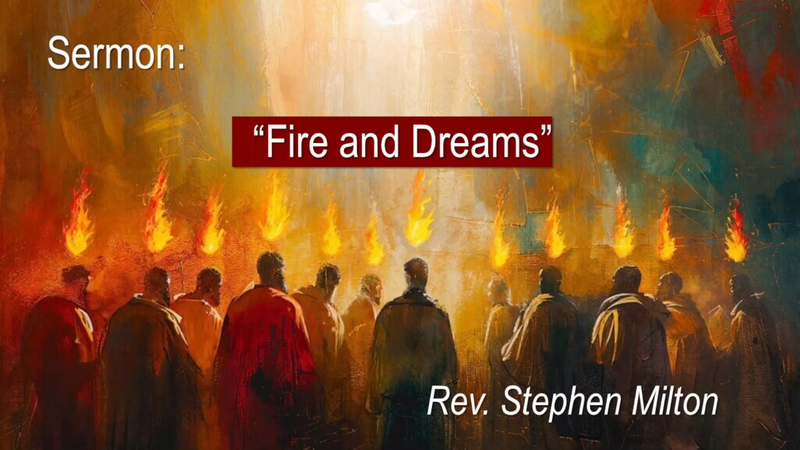
And the Apostles were there, too. The resurrected Jesus had spent 40 days with them ( Acts 1), and so Pentecost is just ten days later. We’re told that they were in a house, when suddenly a mighty wind entered - the Holy Spirit - and then the spirit entered the 12 men, looking like tongues of fire.
Pentecost
The text is really clear that the spirit only looks like fire, it isn’t a fire that will burn their hair or anything else. But this is creative fire. As soon as the holy spirit enters the men, strange things start to happen. These tongues of fire allow them to speak in different tongues.
The Jews from out of town recognize their own languages coming out of the mouths of these Galileans - languages from north Africa, Arabia and Syria. Words these fishermen from Galilee couldn’t possibly know on their own.
This gift of languages is clearly from God, not something these men had on their own. But, still, when these gifts land, they are an enormous surprise, even to the people who receive them. On that Pentecost day, the crowds are shocked to hear these mean speaking in foreign languages. Some take the hint - God’s spirit is here doing something extraordinary. But others just scoff. They try to explain it away, saying these men are just drunk first thing in the morning.
But Peter comes to their defence. He justifies their new ability by quoting from the book of Joel in the Hebrew Scriptures. It predicts that when God comes to save the world, everyone who follows God will be given the power to be prophets. Old men, and young children, slaves and free will have visions and prophetic dreams. Peter quotes this to remind the Jews that God said this would happen. And here it is on this day - a bunch of common fishermen and farmers, Christ’s apostles, suddenly imbued with foreign languages after receiving the fire of the holy spirit.
In the book of Joel, when people start having visions, it is the prelude to God’s arrival and the judging of the living and the dead ( Joel 2) . Peter and the Apostles believe this, too. Christ’s life, death and resurrection, and now this speaking in tongues - it must mean time is up. The old world is about to end, and God through Jesus will create a new heaven and Earth. The world is about to be rebooted.
But, as we know, that isn’t what happened. The world did not end. It appears God had a different plan. Instead of ending the world when God draws near, God wants to take up residence within people. God wants the holy spirit to get inside of us. Starting with the Apostles, this fiery holy spirit is meant to empower Christians to change the world. In the prophecy that Peter quotes, this capacity to dream God’s dreams will be available to everyone - old men, old women, young people, even slaves, the people who are least regarded in society.
No big revolution, just a slow change where common people carry a dream that inspires others to think of the world in a different way. These early Christians will fan out across the Roman Empire. They will come into towns with a bizarre message. God loves slaves just as much as free people. God loves women as much as men. God wants everyone, the poor, the weak, the ill, to be treated well, so they can thrive. This is all heresy by Roman standards, where hierarchy was everything. And this message gets some Christians killed. But that just seems to convince more people to join the movement . They ask to receive this fiery spirit that gives people such courage, to even stand up to the Roman Empire.
In our day, when we think of radical social change, we tend to think of it in terms of revolution. Many revolutionaries want to change society over night, an idea made popular by Marxism. Many socialist revolutions wanted to completely change society all at once - economics, politics, usually the outlawing of religion, too. This happened in Russia in 1917, and China in 1949 and again during the Cultural Revolution in the 1960s. Overnight, yesterday’s rulers are enemies of the state, and must be imprisoned, re-educated, or executed. To this day, this pattern continues in military coups in Africa.
This version of revolutionary change has been a force of great misery, all over the world. It suggests that there are two types of people: friends and enemies. There is no negotiating with your enemies. They must be hunted down or annihilated, as we have seen in the wars in Ukraine and in Gaza.
This stark us-and-them thinking has infected politics in the West, too. The United States appears to be in the midst of a political revolution, where one side wants to erase the power of anyone who opposes it.
Elections
The Republicans do not want to co-operate with the Democrats. In fact, they want to wipe them off the political map, making it harder and harder for them to get elected at all.
This all-or-nothing idea of social change is dangerous. It is a long way from Christ’s teaching that we should love our enemies, and help them when they suffer. And it is a long way from what the Apostles did at Pentecost. They did not use the holy spirit to set fire to Roman society. They did not take up arms against the Roman Empire. Instead, they let the fire of the spirit push them into new lands, speaking new languages, spreading a message of love and understanding. Even when it meant risking arrest and death. They introduced a new way of thinking about humanity into Roman society.
That strategy can still work in our day.
Serviceberry
In a recent book, The Serviceberry, Indigenous author Robin Wall Kimmerer talks about how in nature, living things help each other. The serviceberry tree produces sweet red berries each year - you may know them as Saskatoon berries.
The tree doesn’t need all those berries to reproduce, it just shares them with birds and bugs, who carry its wealth away with them. Then they discard the hard seeds, allowing the tree to sprout elsewhere. She calls this a natural gift economy. Indigenous societies have long practiced gifting in the same way. They often share items without selling them. They give objects like tools and quilts that are expected to be used and then gifted again. Giving, not selling, was a key part of Indigenous society, and still is.
In our society, we like to sell things. Most things have a price. Even when we give gifts, most of them are purchased, and we frown on re-gifting a present. But, we can see where all this selling gets us. We buy things that just end up buried in the land fill, or worse, floating in the oceans. Kimmerer suggests that what the world needs now is more face to face giving and less faceless selling. But, she says, we don’t need a revolution to get there:
“I don’t think that market capitalism is going to vanish; the faceless institutions that benefit from it are too entrenched. The thieves are very powerful. But, I don’t think it is pie in the sky to imagine that we can create incentives to nurture a gift economy that runs right alongside the market economy.”
-Robin Wall Kimmerer
If we think we need to take over and win to change the world, we are likely to succumb to despair. But we don’t need to be in charge to fight the evils of the world. We just have to show that doing good is possible. To do good within a system with problems. Let us dare to start small, and not worry about winning. Just do good, and if it works, do some more and let it grow. Like a tree.
As Christians, we have been called to be a place where the creative fire of the Holy Spirit can dwell. A people where common folk can have dreams and visions, and then go out and put them into practice. We can all see that our world needs fixing. Politically, ecologically, economically. Like those twelve Apostles, we need to be the people who speak new languages about what can be done, gently, starting small. Let a few sparks become a fire that glows in the darkness, giving guidance to others who feel lost. Let’s allow ourselves to be more daring, asking simply for God’s help to make the world a better place for all people and species. And if someone else has a compassionate good idea, let’s help them. They, too, may be dreaming dreams. God will show the way if we are willing to listen, and dream, and entertain visions. Amen.

%20(4).png)