
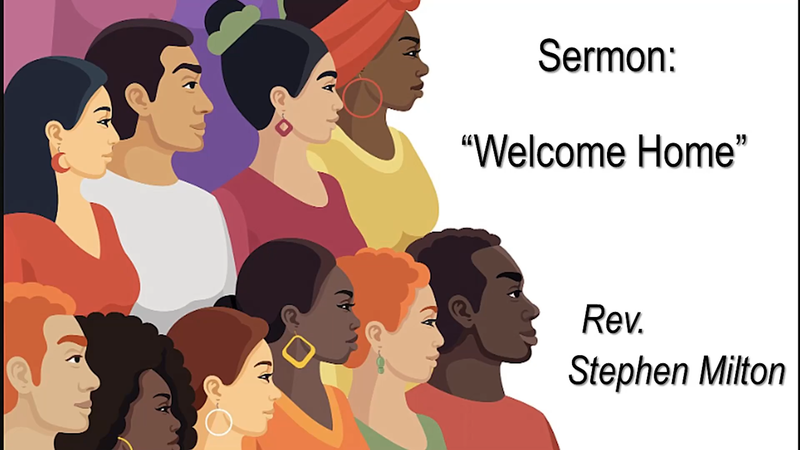
“Welcome Home”
Rev. Stephen Milton
Lawrence Park Community Church,
June 28 2026
Pride Sunday
Matthew 10:40-42.
“Welcome” It’s a word that we use a lot in church. I use it every Sunday morning when I get up here. It means we are glad to see you and we invite you in - it’s the kind of word a host uses.
Twenty years ago or so, the United Church of Canada put a big emphasis on congregations being welcoming to anyone who walked in the door. Most churches took to this easily. Their numbers were declining, and they desperately wanted new members. So they agreed to be welcoming, but it often came with a catch. Congregations wanted to welcome new people to keep their church alive. They were not saying “we welcome you and we are willing to change our ways to accommodate you." There’s a difference between welcoming someone to become a friend, and welcoming someone to just fit in to what is already here.
Fortunately, within the United Church, there is a recognition that part of welcoming is being willing to change. That’s one of the reasons the Affirming process exists. It is a process dedicated to educating congregations about the identities, needs and hopes that LGBTQ2S+A people bring with them when they enter a congregation.
That can sound like churches do the affirming process so queer people can finally join their church and feel safe here. But that’s inaccurate.There have always been queer people in church congregations. Every time there was a large Sunday school program, with lots of kids, there were queer people in the room. Roughly ten percent of people are queer, and that includes children. Some of the the little kids running around a crowded Sunday school class may already know they aren’t straight or cisgender. Some will figure it out later. But no matter what, when you have a big Sunday school class, there are already queer people in the church.
The same is true among the adults in the congregation. Church congregations usually have queer adults, even when the church is officially hostile to queer issues and identities. Back in the days when hundreds of people came to this church on Sunday mornings in the 1950s and 60s, there were gay people who had chosen to pass as straight. Some were married, some were confirmed bachelors, or “spinsters” with a close friend at home. Some were obviously queer, but people chose not to talk about it. Gay people have always been in churches. The question was whether the church would welcome them, knowing they were queer.
The United Church of Canada understood this when they created the affirming program. It was not to bring queer people into the church - they had always been here. Instead, the affirm program was created to educate congregations about queer identity and their needs, so queer people could feel comfortable here, as newcomers, or as long time members. This church entered into that process 6 years ago. It took eighteen months, and it featured many educational sessions as people learned about the wide range of sexualities and genders which exist. We learnt about the range of pronouns people in the queer community use, and why respecting those pronouns is part of treating people as equals. And people here made mistakes, and will continue to make mistakes. And, we recognize that queer culture is not static. Terms that made sense 10 years ago no longer apply now, so education is an ongoing process.
Thanks to that affirming process, we became an officially affirming congregation in 2022. We earned the right to use the Affirm flag, which is on display on our outside wall. And our council decided to make the affirm committee a standing committee as part of our church constitution. This was done because we could acknowledge that being affirming is an ongoing process, it is not one and done. Queer identities and culture continue to change, and it is important that we keep up with those changes. So, we have had sessions on trans identity and pronouns. It also means understanding the role our religion has played in making life difficult for queer people. Recently, we watched a documentary about how the word “homosexual” was introduced into Bibles in 1946, and later taken out. You can see that evolution on a table out in the gathering hall, using bibles from our own library.
Being welcoming means being willing to change. We ask everyone here to respect each other’s pronoun preferences. To respect how people choose to dress as they express their identity. We don’t expect everyone to look the same, or express their gender or sexual identity in the same way.
At LPCC we felt it was important to broaden the definition of affirming beyond sexuality and gender. We want everyone to be welcome here, so we have geared our educational sessions and policies to include discussions about disability, Indigenous cultures, racism, sexism and other forms of exclusion. It was the Affirm committee’s idea to add subtitles to our screens in the sanctuary to help those who are hard of hearing. That, too, is an accessibility and inclusion issue. Last year, an automatic door was added to one of the washrooms, to make it easier for people in wheelchairs to get in. The Affirming process is ongoing, not one and done.
Sometimes people explain this with an analogy to a dinner party. Hosts show respect when they ask their guests if they have any food allergies or restrictions, like if they are vegan or sensitive to gluten. Afterall, there’s no sense in serving a dinner your guests cannot eat. So, a good host makes sure that everyone who enters their house is given a fair chance to be fed. In worship services we do this by offering gluten-free bread, and juice instead of alcohol.
In today’s scripture reading, Jesus is speaking about what it means to be welcome. He is talking to his disciples before he sends them out into small towns to continue his work. They have been given the power to heal people of illnesses and demons. Jesus knows some of his disciples will be rejected and kicked out of town. But in other places, they will receive a welcome, and find a home where they can sleep. And those people, who give Christ’s disciples a place to stay, will be getting more than they bargained for. Jesus declares,
40 “Anyone who welcomes you welcomes me, and anyone who welcomes me welcomes the one who sent me.” ( Matthew 10:40)
To welcome one who comes in Christ’s name is to welcome Christ, and by extension, God. So, it is no small thing to welcome these disciples into one’s home. They are attached to Jesus and God by an invisible cord that reaches up into heaven. And this hospitality comes with blessings:
41 Whoever welcomes a prophet as a prophet will receive a prophet’s reward, and whoever welcomes a righteous person as a righteous person will receive a righteous person’s reward. 42 And if anyone gives even a cup of cold water to one of these little ones who is my disciple, truly I tell you, that person will certainly not lose their reward.” ( Matthew 10:41-2)
The one who provides hospitality to a prophet will get a share of the prophet’s reward in heaven, even though they are not a prophet. It is like in the act of welcoming a blessed person, the host receives part of that blessing. It rubs off, the host becomes enveloped in that cocoon of blessing. To welcome God’s most humble messengers with something as simple as a cold glass of water is to welcome God and God’s stream of life and love.
Churches are like houses, too. We call them the house of God. In theory, every church would be welcoming to all people of all kinds. But in practice, that has not been true. Churches have acted as if these buildings belong to its congregation, and we get to decide who is allowed in. In that way, we are like people in the towns that the disciples visited. Would they let the disciples into their homes to sleep over night? Would they offer them sanctuary, a home base where they could eat after a day of healing and teaching in town?
In our time, we don’t expect travelling preachers to walk in the door with the Christian message. Instead, we receive the message of God’s compassion and love through scripture. The disciples and Christ’s message arrives in words. Every church all over the world reads scriptural passages out loud every Sunday. We preach on them, sing about them, meditate on them. The question is whether we will welcome the message contained in these passages, or will we water them down, or even reject them? Will we ignore their call for radical welcome for all of God’s precious children?
A core part of the Christian message is that everyone should be welcomed into these houses of God. And, in our understanding, that includes queer people. Welcoming them as precious children of God allows us to live up to the call of scripture and Christ’s message of love.
But, if we are acting like the hosts who invited the disciples in, can we expect a reward of some kind for this act of hospitality? None of us know what rewards await us in heaven, that is up to God. But there are a few benefits which we can feel in this life by being welcoming.
First, we finally give queer people who were already here a chance to be themselves. To finally feel at home, and without any need to live a double life. It is up to them what they choose to reveal, if anything, but now they can know it is safe to come out. That is a key part of God’s welcome.
Second, in welcoming queer people, we recognize that God’s creation is more rich and varied than our culture suspected. We recognize that gender comes in many forms, and so does sexuality. Our understanding of what it means to be human is broadened. And so is our understanding of God. For, if we are made in God’s image, all of us, then God is not as simple and predictable as we thought. God loves variety and its expression. That variety will be on full display this afternoon at the Pride parade. God is not a boring old humbug insisting on a few narrow categories of being. A God who welcomes queer people is a more interesting God than we embraced before. God has not changed, but our view of God can change.
And finally, when we welcome queer people explicitly, we broaden our moral imagination. We become more ready for others who have been excluded but who also belong here. To be welcoming entails a suspension of judgement and an activation of curiosity and compassion. There are other groups who have lived in the shadows who long to be welcomed explicitly. Our society is becoming more sensitive to the needs of the neurodiverse, and people who deal with different kinds of mental health issues. Churches are called to be a safe place for all, a sanctuary, and with the help of the affirming committee, and you, and others, we can continue this work of making this house truly God’s house, where all are welcome. Welcome to those who are already here, and those who may walk in the door. Amen.

%20(4).png)