
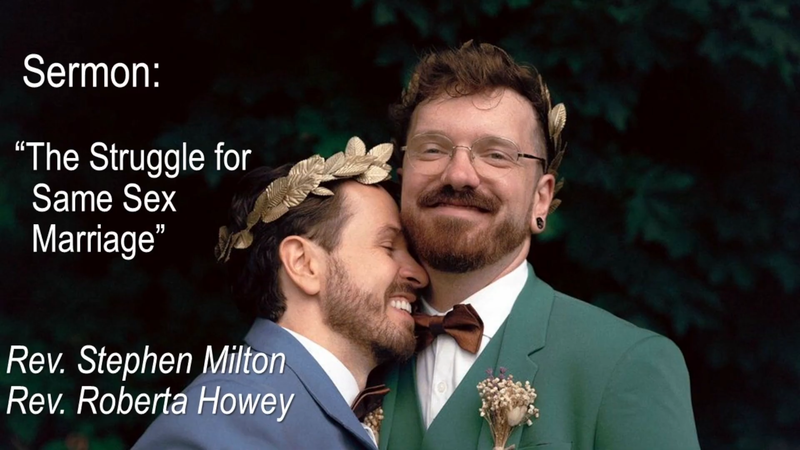
“The Struggle for Same Sex Marriage”
Rev. Stephen Milton & Rev. Roberta Howey
June 14th, 2026
On June 1st, I attended the annual Pride flag raising ceremony at City Hall. I had been invited to come by one of the speakers. The reason I had been invited was that 2026 marks the 25th anniversary of the first legal same sex marriage in Toronto, and probably in North America.
I witnessed some of the events that led up to that wedding, and it turns out that Rev. Roberta also has a personal connection to same sex marriages as well. So today we’re both going to tell the tale of how the legalization of same sex marriage came about.
I’m going to hand it over to Roberta now to give some background about what was happening in the 1970s and 80s, before it was allowed. Roberta?
In the UCC, I get to do same-sex weddings and queer weddings. They are a chance for two people to show their love to each other and the world, and often they come with a sprinkle of rebellion. Pride Parades started as protests, and queer weddings started as illegal and rebellious acts against the government. What more could a follower of Jesus ask for?
When we think of LGBTQ+ couples, there is an image of them not really appearing until the late 20th century, and only getting married when it was legalized. And that is not entirely accurate.
There have always been men and women who have lived with “roommates” or “cousins”. Living with someone was not a crime. But the accusation of a homosexual relationship was always an axe looming over the heads of couples across the country. Your family, neighbours, someone who has a grievance with you, could report you to the police. Suspicion was enough to make people relocate their entire lives in search of a safe city. They would come to the village in Toronto, or Ottawa or Montreal, or Winnipeg. Their relationship was breaking the law until 1969, and afterwards was a massive social taboo for most of the country.
But their love was always there. It existed outside the law, persisted beyond social pressure. And now, here we are.
Society wanted to have their cake and eat it too. Homophobia wanted the fact that same-sex marriage was illegal to be evidence that queer people could not be in loving committed relationships. So, couples around the country, further emboldened by how that sodomy laws were repealed and they could exist relatively legally, said “let’s get married anyway”.
These were still not legal marriages. But they had all the hallmarks of any other wedding you and I have seen. A couple, dressed up at the front. They shared vows, exchanged rings. An officiant walked them through the blessings, and they sealed the deal with a kiss. Sometimes, there was paperwork!
[UU Minister certificate]
This was Chris Vogel and Richard North, who got married in 1974 in Winnipeg. Their marriage was still not legally recognized, and as late as 2021, this 1974 document is not valid, but for them, for God, for their community, this was and is as legit a marriage as any other.
One that is closer to home for me is Ken DeLisle and John Robertson. John is my uncle’s brother, and John and Ken went on to be the first openly gay clergy couple in the UCC. They met in Ottawa, at a Catholic conference where they were working to have gay and lesbian Catholics recognized and legitimized. They quickly fell in love, and when back in Winnipeg, began their relationship. They had a witnessing in 1979, as seen here.
[JOHN AND KEN PHOTO]
It was a small event, with their friend officiating the wedding. But Ken still considered himself a Catholic at the time, and was attended by their friends of the Winnipeg gay community. It would be years before both John and Ken would join the UCC, and begin their process of ordination and diaconal ministry. This was the most common way that gay and lesbian couples would get married, with a rogue clergy person or a dear friend officiating outside the law. Because love could never be dictated by the law.
Before handing this back to Stephen, one note about where the UCC was in all of this. Last year I talked about how the United Church spent the 1980’s exploring if and how Lesbian and Gay members could seek ordination. One of the arguments that moved through the denomination is that they could not have their minister “living in sin”. An unmarried minister living with their unmarried partner? Absolutely not, that is against morality and doctrine. But if they could be married? Sure, that could work. And so we start to see some pieces fall into place. What if same-sex marriage was not just a fringe idea? What if there was a way the church could make it a moral, religious, and political good?
Stephen takes over
Thanks Roberta. As you heard, gay couples had been wanting to get married legally for a long time. In the year 2000, there were at least 7 churches in the city that were holding wedding ceremonies for gay couples. Most of them were United Churches. But by far the majority of those weddings were being held in one church that was not a United Church. The Metropolitan Community Church was the clear winner in this regard. The lead minister was Rev. Brent Hawkes.
Brent Hawkes
Each year, close to Valentine’s day, he would hold a mass wedding, where over a hundred gay and lesbian couples would say “I do”. Rev. Hawkes directed them to sign the church wedding registrar like at any other wedding.
But despite all this, these weddings were not legal. These couples were not able to get wedding licenses from the city, or marriage certificates from the province.
In late 2000, Hawkes announced that he had figured out a way to marry queer couples legally. He would use the ancient Christian tradition of reading the banns. A minister simply has to read out an announcement of the upcoming wedding three Sundays in a row. ( You may remember that we had a banns wedding here a couple of years ago when George and Donalda were married). The congregation is given a chance to voice any objections they may have to the union, such as if one of the couple is still married to someone else. If there are no objections, after the third reading, the wedding can proceed. The paperwork for the banns doesn’t mention male or female, so Hawkes believed this should be legal. So, in late 2000, he read the banns for two couples, one gay, the other lesbian, with plans for a wedding ceremony in early 2001.
During this time, I was a congregant at another church, across town in the west end. It was called Emmanuel Howard Park United Church. I had started going when my first son was baptized in 1995. The church was small, with little money in the bank, and a shrinking older congregation. Still, it had a good heart, and it was the first Christian church I had ever attended, and I liked it. It was also down the street from my house.
In 1999, the church hired a new minister who had an explicit interest in church growth and evangelism. Her name was Rev. Cheri DiNovo.
Cheri DiNovo
She was full of energy and ideas, and a very charismatic preacher. She energized the congregation, and was very strong on social justice issues and queer rights.
Cheri wanted our church to grow. So, when she learnt that I was a film maker, she asked me to run our communications and help with church growth. I was soon sending out our weekly emails, and running our website. It was my job to get the message out to the rest of the world through events, bus shelter ads, whatever worked.
In Cheri’s sermons, she often said that God is love, drawing on the message of today’s scripture reading. If God is love, then that means that wherever we find love, we find God. To Cheri that meant God endorses all forms of consensual love, which includes the love between gay and lesbian partners. Cheri was also very clear that we are all made in God’s image. God loves every single human being just as they are. This meant that back in 2000, she declared very clearly that our church was a safe space for trans people. This attracted trans people, one of whom became part of the staff.
So, back in 2001, when Rev. Hawkes was getting ready to hold that first gay wedding using the banns, Cheri was totally on board. She supported what Hawkes was doing, and we knew it was happening.
January 14 2001 wedding
On January 14th, 2001, Rev. Hawkes read the banns for those two couples for the third time. There were media from all over the world present, and the church was packed. I was not there, but it was easy to follow the story in the newspapers.
Hawkes sent the signed banns forms in the mail to the provincial registrar, declaring that these marriages were legal according to the law of the land.
The province disagreed.
Lawsuits
It rejected both of the marriages, repeating the claim that marriage can only be between a man and a woman. Rev. Hawkes engaged a lawyer to launch a lawsuit against the province for discriminating against these two queer couples.
Court cases take a long time, so it seemed like the issue of gay marriage was going to go quiet for at least another year.
But back at my church, Emmanuel Howard Park, something interesting happened. A few months after the controversial MCC weddings, a lesbian couple approached Rev. Cheri, looking for someone to marry them. They were both originally from Latin America. Cheri agreed to do it. Cheri didn’t mention this to the church council, but was confident she would have our support, and she was right.
The couple didn’t want a media circus for their wedding, so it was kept quiet. Cheri read the banns three Sundays in a row in September of 2001.
The couple
The couple had a small wedding ceremony at the church a little later. Cheri signed the banns form and sent it off, expecting the same result as before.
But, when the form arrived in Thunder Bay at the registrar’s office, something funny happened. Perhaps it was because both names were Latin American. Perhaps the registrar was having an off day. Perhaps it was because the form stated one person was the bridegroom and one was the bride. Perhaps the registrar had a change of heart. Whatever the reason, the form was signed, making the marriage legal.
On Valentine’s Day, 2002, the women received the signed marriage certificate in the mail.
Marriage certificate
Their lesbian wedding was now officially the first legal same sex marriage in Ontario, and in Canada. Our little church had made history.
Same Sex Marriage Recognized
Now, Cheri being Cheri, she did not want this to be a secret. So the press found out, and the province found out, too. They were not happy.
The registrar sent a letter to the United Church Toronto Conference asking them to take away Cheri’s license to marry people since she had tricked them. The UCC did nothing about it, to Cheri’s frustration. So, Cheri hired a lawyer who sent a cease and desist letter to the province. And it appears that worked, the province dropped the matter, and the marriage was allowed to stand. That same year, the Ontario courts ruled that denying marriage to queer couples violated their human rights. The stage was set for these weddings to become legal, and it became federal law in 2005.
But the first legal same sex marriage took place at our west end church in 2001, even before the laws were changed.
Keys to the city
And for that reason, on June 1st, of this year, 25 years later, the Mayor of Toronto gave the key to the city to Rev. Cheri DiNovo, as well as the current minister of the Metropolitan Community Church, and four other faith leaders who performed same sex weddings before it was legal.
The Mayor proclaimed that Toronto is for love, and sometimes churches need to get ahead of the law to make things right. Cheri was given a couple minutes to speak, and she asked me to stand up as a representative of our church from those days. I can’t take any credit for what happened, but I was happy to help . Our congregation learned that if God is love, churches are sometimes called to get ahead of society, and even get ahead of the law, to lead society into a more compassionate and fair future. God is love, and that simple statement is just as radical today as it was when it was written 2000 years ago. Amen.

%20(4).png)